The crown princess
Aveline Orinth is a princess and the recognised heir. Her childhood was spent being groomed to rule, and her formal designation is Psionic Adept. She has a younger brother. Her long dark hair frames brown eyes, dark brows and an oval face narrowing to a small chin.
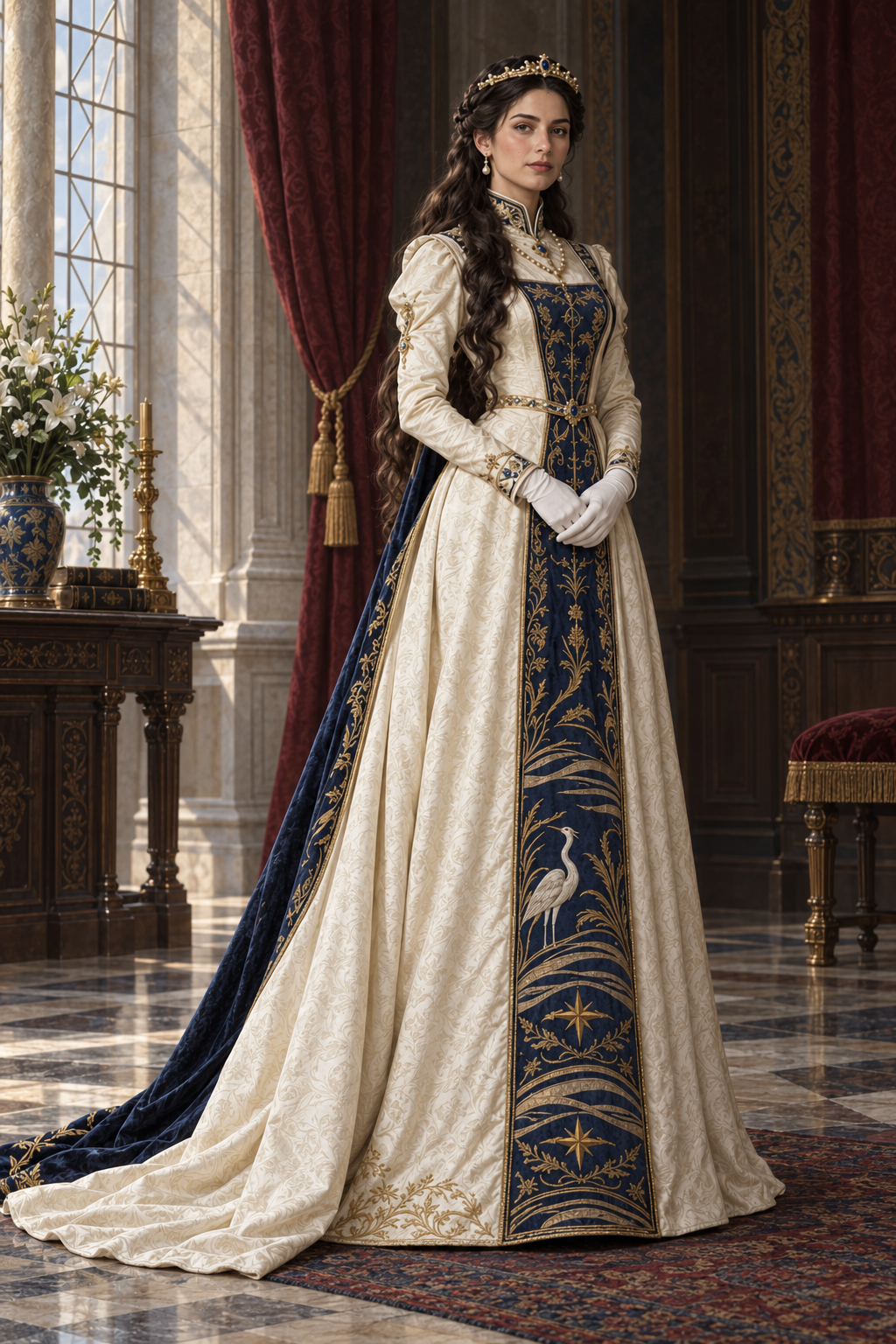
Small recollections are more revealing than the title. She could braid her own hair. Before leaving the inner provinces, she asked Merren whether he had ever seen a frontier world. Merren had not; she anticipated that they would have something new to discuss when they came home. Her curiosity was real, although curiosity alone does not establish how patiently she would have listened.
Merren’s account of her kindness is mixed. She noticed when people were unhappy but did not always accept that their reasons should outweigh her wishes. His testimony comes from one familiar witness, not an impartial measure of her whole character. It supports a young woman capable of attachment, certainty and care that could become possessive.
A household before a dynasty
Aveline spent her childhood in Velisar, principally within the river-facing royal residence and its gardens. Her mother is Empress Ysabet; her father is Consort Temren. The palace was a home with favourite landings and places where voices carried, as well as an institution built to display her future importance.
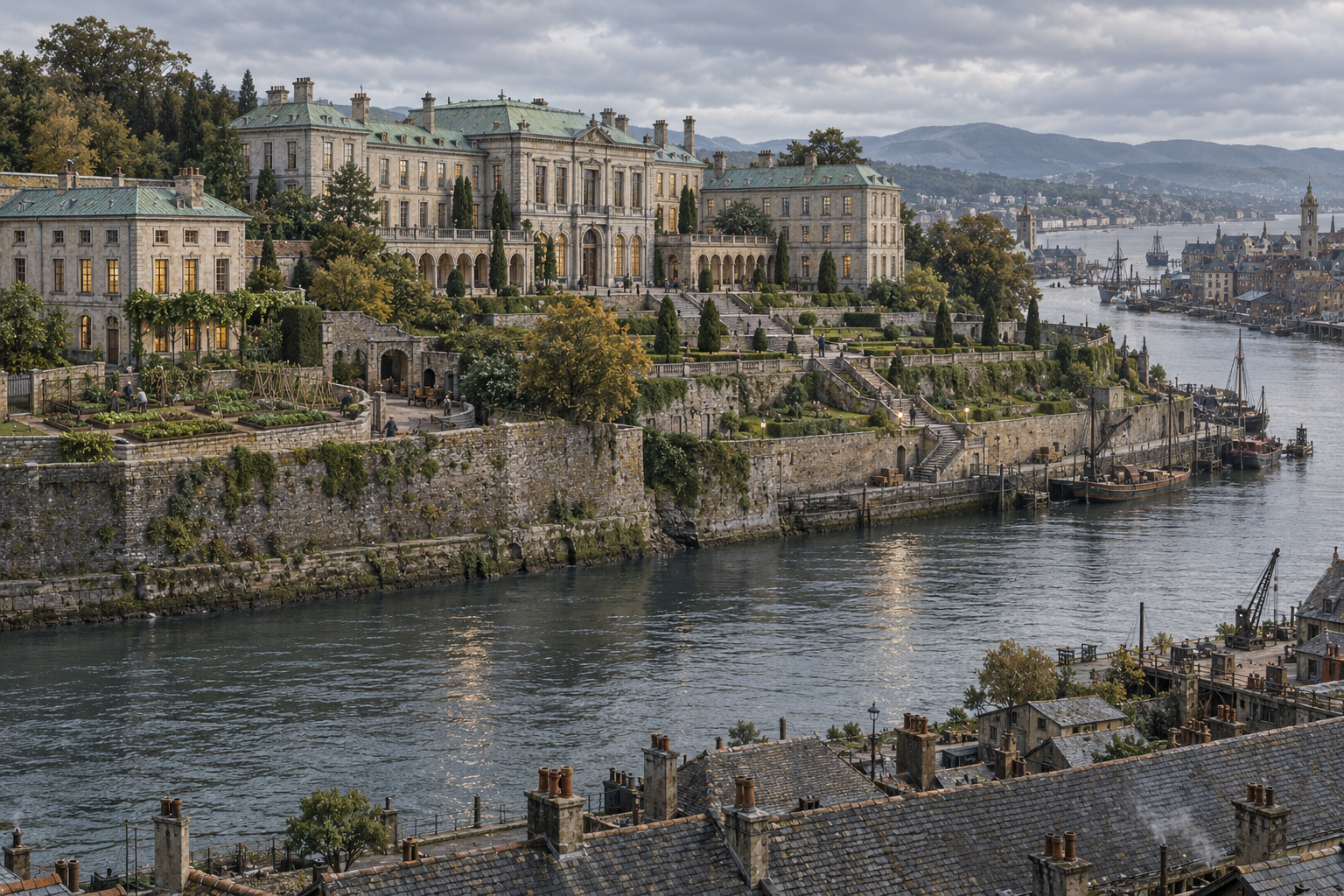
Her father’s interest in civic restoration gave her an early pleasure in before-and-after drawings. She liked a damaged building made whole on a sheet of paper. The less picturesque question of where its residents would live during the work interested her later, when a tutor insisted that she account for it. She was bright enough to learn the answer and sufficiently protected to resent being made to ask.
Her younger brother Odran shared some lessons and most public ceremonies. As children, they collected mistakes made by official portraitists: an extra braid, a vanished scar, the same ceremonial sword attached to three different ancestors. The collection gave them something private to enjoy within an intensely public family.
Learning to be heard
Aveline’s education combined languages, petition procedure, political history, mathematics appropriate to public accounts, supervised psionic practice and the bodily discipline of ceremony. Different teachers rewarded different things. A historian wanted her to qualify a claim. A household instructor wanted her to answer without hesitation. She became skilled at recognising which performance the room expected.
Her strongest aptitude is attentive public speaking: she remembers a petitioner’s name, can summarise a dispute clearly and dislikes losing an audience. She is less practised at allowing a conversation to finish somewhere she did not intend. The distinction matters. Being able to repeat a person’s grievance is not the same as permitting it to inconvenience her.
A room of her own
Aveline kept a desk by a tall window overlooking a service garden. She sometimes watched gardeners work because they were absorbed in tasks that did not require her expression to mean anything. She knew one gardener’s daughter, Lethra, who helped catalogue bulbs during the school recess. Their friendship was neither a secret romance nor a lesson arranged for the heir; it began over the discovery that both disliked the same ceremonial song.
They exchanged books, disagreed about the endings and continued disagreeing after an attendant came to collect Aveline. The friendship acquired a strain when Lethra began applying for work elsewhere. Aveline offered to find her a palace post. It took her too long to understand that leaving the palace was part of what Lethra wanted.
Aveline also liked mornings before the household finished assembling her day. Braiding her hair herself let her choose how much of the morning belonged to conversation.
The procession · a remembered event
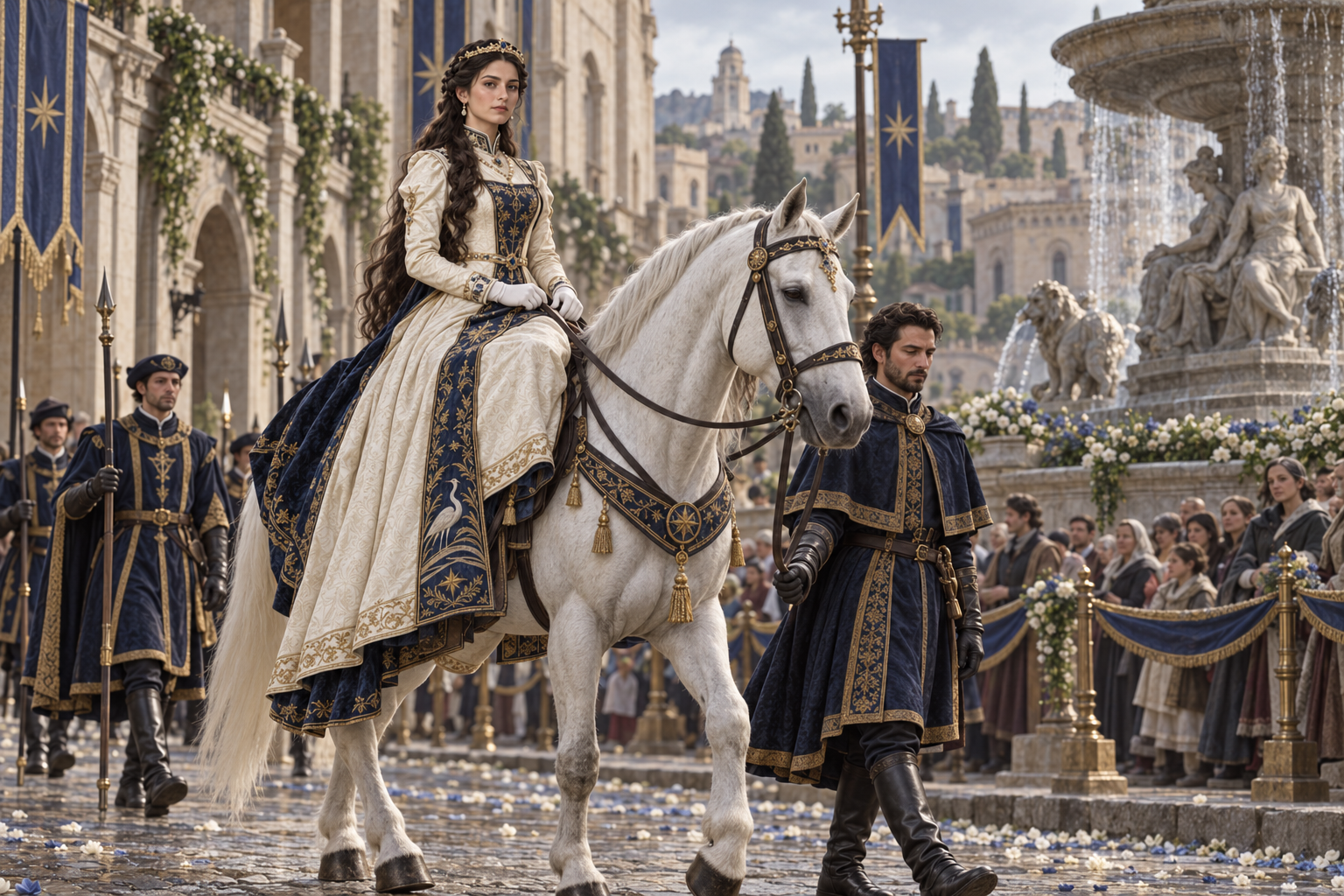
At Aveline’s coming-of-age procession, a ceremonial horse refused to pass a fountain. Her mother, who disliked the horses, addressed the animal about the limits of hereditary privilege. Aveline laughed so hard that attendants thought she was ill. The joke and the dislike belonged to her mother. Aveline’s laughter was her own.
The recollection matters because it preserves a relationship outside official portraiture. A mother could be funny; a daughter could lose control of her dignified expression. It does not prove the mother’s entire temperament, but neither should the portrait’s firm mouth be made to prove that she was cold.
The petition she thought she had solved
Aveline read the summary twice. The tenants wanted their roof repaired before the wet season. The estate steward wanted authority to move them into temporary rooms. She could see a solution, and the ease of it pleased her.
“Give him the rooms,” she told her tutor. “The repairs can begin.”
The tutor laid a second sheet beside the first. Aveline’s smile tightened. She had thought they were finished. The temporary rooms stood beyond the last morning tram. Three tenants worked shifts at the riverside ovens; another cared for a sister who could not manage the stairs.
“They would still be dry,” Aveline said. She heard the impatience and disliked that he had heard it too.
“Yes,” he said. “That part of your answer works.”
She wanted him to admire the useful part. Instead, she turned the sheet towards the light and asked what transport the estate could provide. The amended recommendation cost more. For the rest of the afternoon, she was annoyed with the steward, the tutor and the original summary. She kept the second sheet.
At the next review, she defended the cost of an early transport run. The estate board approved a hired minibus for the weeks of repair. Aveline asked for the first attendance report and learnt that the three oven workers had kept their shifts. The sister who could not use the stairs still needed different rooms; Aveline referred that problem back instead of marking the petition settled.
Why Tarsenne mattered
The established purpose of her voyage was to hear the coastal settlements’ petition against North Quay’s customs claim on behalf of the Orinthian court, before returning to the inner provinces. It was an assignment with people and consequences attached.
Her personal ambition is straightforward: she wanted an assignment she could later describe without referring to what her mother had decided. She hoped to return with a judgement that would survive informed criticism. That hope could coexist with impatience, excitement about the journey and an incomplete understanding of the place she would visit.
The biography ends at departure. Aveline leaves with skills, memories, attachments and unfinished disagreements. Those belong to her. Her friendship with Lethra remains unresolved, and the work she expects to do on Tarsenne has not yet been tested against the people who live there.