Sedge Coast and western valleys
Zoom, pan, search named places and follow links between maps.
1. Identity and reference
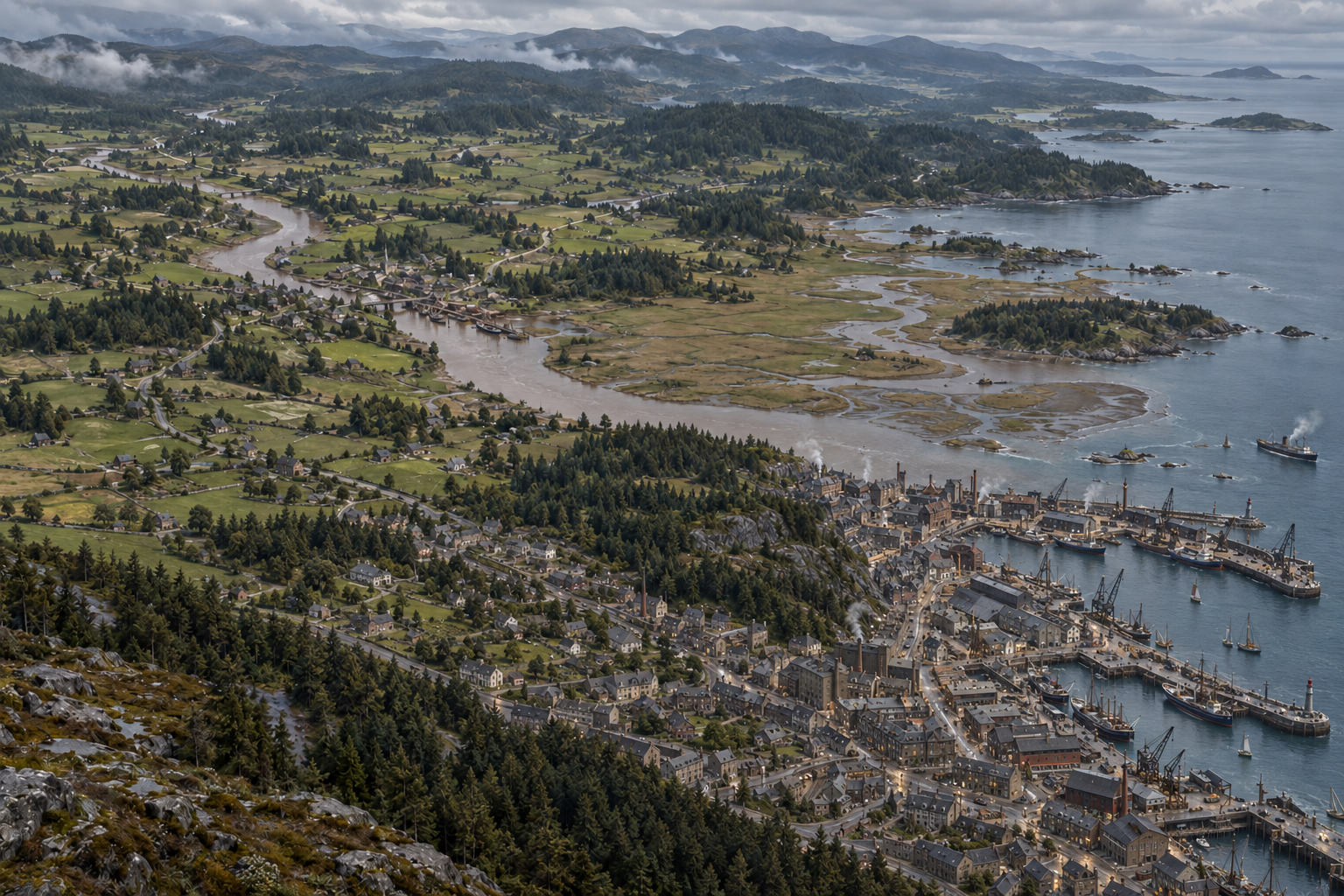
Sedge Coast is a regional name used by carriers and mapmakers for the wet western margin of this part of Rauth. It describes sedge flats at the river mouths, not a people of one ancestry. There is no national crown, flag, anthem or capital. North Quay flies its port pennant, a pale hook on a dark green field; village boats display their own owner and landing marks.
A survey district of roughly 18,000 square kilometres contains an estimated 74,000 residents, including farms and dispersed homes. These figures count a region, not subjects of North Quay. The port’s built-up settlement accounts for about 21,000; Reedbank about 1,800. All are rounded estimates for the opening reference period, assembled from household counts with gaps in the outer farms.
| Reference | Description |
|---|---|
| Principal port | North Quay; no common regional capital |
| Six petitioning settlements | Reedbank, Three Reeds, Willow Brake, Fenstairs, Alder Hook and Moss Landing |
| Money | Weighed silver; material exchanges by agreement |
| Language | Coastal trade speech alongside household and travelling dialects |
| Public authority | Local councils and customs officials with disputed geographical limits |
| Imperial presence | Commissioner’s limited protection, communications and treaty remit |
2. Coast, river and inhabited ground
The Sedge is the brown river passing Reedbank before turning towards its tidal mouth. Its colour comes from suspended sediment, not a single permanent contamination. Reedbank’s houses and gardens occupy raised ground; working banks below them give boats access to water. A repair yard can tolerate wet boards that would make a bedroom uninhabitable.
North Quay stands beneath a high western bank beside a sheltered eastern harbour. A coast road reaches it from the south; an upper road climbs inland. Marsh growth, channels, private fences and seasonal washouts complicate direct journeys. A short line drawn across the map is not a usable road.
The climate is wet temperate, with colder uplands beyond the coast. The surveying office at North Quay records roughly 1,450 millimetres of annual rain as a recent ten-year mean, with a broad working range of 1,100–1,900 in that station’s record. Reedbank has no identical instrument record. Fog, river height and wind direction often matter more to a departing boat than the annual mean.
Bird Flats, north of the harbour, are seasonal nesting ground for coastal terns. Fishing households maintain no-cut reed patches that shelter young fish; enforcement depends on neighbours as well as notices. Local landing associations arrange the closed cutting periods and hear complaints about boats disturbing nests.
3. Charter history
The coastal register dates its working landing-rights charter to SR 527. Earlier settlement, exchange and property histories survive in household deeds, remembered boundaries and reused works. The charter recognised obligations and existing landing rights; it did not conjure villages into existence.
Later customs leases gave North Quay income and duties associated with deep-water access. The present dispute concerns whether its chargeable area extends to independent landings. Multiple copies and later surveys do not agree. The six petitioning settlements seek a hearing of those claims. Their petition has not produced a new common constitution.
| Record | What it can establish | What it cannot establish alone |
|---|---|---|
| Landing-rights charter | Recognised rights and obligations at the time of the instrument | The truth of every later boundary drawing |
| Customs lease | Particular charges and contracted duties | Universal sovereignty over the coast |
| Household deed | An asserted chain of property and signatures | An automatic right to block public maintenance access |
| Petition | The settlements’ objection and request for adjudication | The eventual finding of the hearing |
4. Government, law and practical authority
North Quay’s port council appoints customs officers and supervises its harbour works. Its council chamber sits in the guildhall. Reedbank makes its own local arrangements; its market and surgery do not become imperial institutions because an imperial representative visits. The other petitioning settlements send delegates authorised for the dispute, not permanent legislators of a country that does not exist.

Commissioner Sorn’s station handles a limited portfolio of protection, communications and treaty business. Treaties require interpretation, and his office needs cooperation and supplies. Aveline’s scheduled hearing gives the coast a route into imperial adjudication without making every resident her subject.
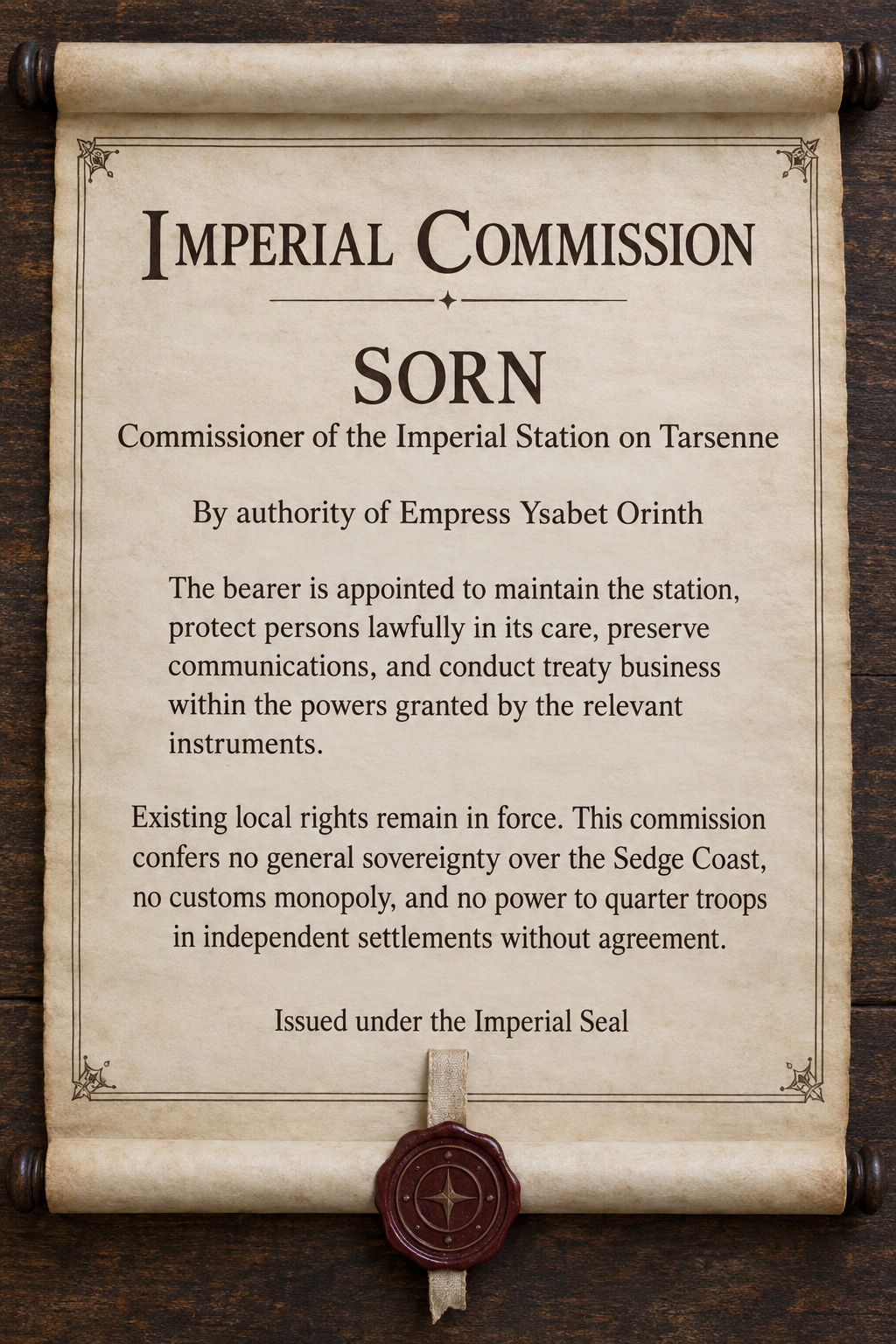
For ordinary disputes, residents begin with local witnesses, deed custodians or a council hearing. Serious coercion creates problems of force as well as paper. Someone who wins a small claim may still need help enforcing it. Conversely, the absence of an imperial policeman on a lane does not mean its residents possess no law.
There is no single coast-wide electoral roll or complete legislative code. The North Quay council’s procedures and each settlement’s arrangements must be described separately. The regional directory therefore names functions and places rather than inventing a national cabinet.
5. Work, money and exchange
Fishing, gardening, boat repair, ferry work, small-scale cropping, timber handling and the sale of services connect the coast. Imports include fastenings, medicines, sound batteries and parts requiring machinery the local workshops lack. Exports leave when freight terms make them worth carrying. A rich catch is not income until someone buys, preserves or transports it.
Silver is ordinarily weighed, with fineness and accepted pieces affecting the bargain. Istra Harn charges for repairs and sometimes accepts useful material by agreement. She pays Osen for trial mornings she can afford; an imagined regional wage index must not erase the real uncertainty of her order book.
Port credit is secured against cargo, facilities or future revenue. That brings repairs forward but can leave a borrower with little freedom when income falls. North Quay’s lease disputes and debts make control of a warehouse doorway politically significant. This is a local credit economy, not evidence of a planetary central bank.
| Work or household need | Payment basis | Exposure |
|---|---|---|
| Hull repair | Quoted job, deposit and balance | Material delays and concealed damage |
| Landing and loading | Weight, berth and labour charges separately stated | Disputed customs limits |
| Garden produce | Market sale or household exchange | Floods, spoilage and missed market days |
| Imported medicine | Cash or a recognised account | Transport and storage losses |
| Casual unloading | Agreed shift or load | No promise of another shift |
6. People, teaching and care
The coast’s residents include long-established households, recent arrivals, seasonal workers and people who no longer have an address elsewhere. Port household registers tend to undercount lodgers and crews between voyages. A claimant’s inability to produce an old local deed does not establish that they have no history or relationships.
Reedbank’s surgery occupies its former school. Current instruction is organised in small borrowed rooms and households, with scheduled reading and counting lessons when space and teachers can be paid for. Children also learn by watching work, which teaches useful things and sometimes the wrong shortcut.
In North Quay, the High Bank infirmary has a small ward, a treatment room and a dispensary. Payment comes from contributions, fees and council support; the balance is persistently disputed. Reedbank retains its established surgery and Roel’s role. These facilities have different reach and resources. A city hospital is not automatically available to someone upstream without transport.
Widowed residents, injured workers and isolated children draw on kin, neighbours, subscriptions and imperfect local provision. Assistance can be kind, conditional or humiliating. Neighbours also help because they know what a long night costs.
7. Culture, belief and communication
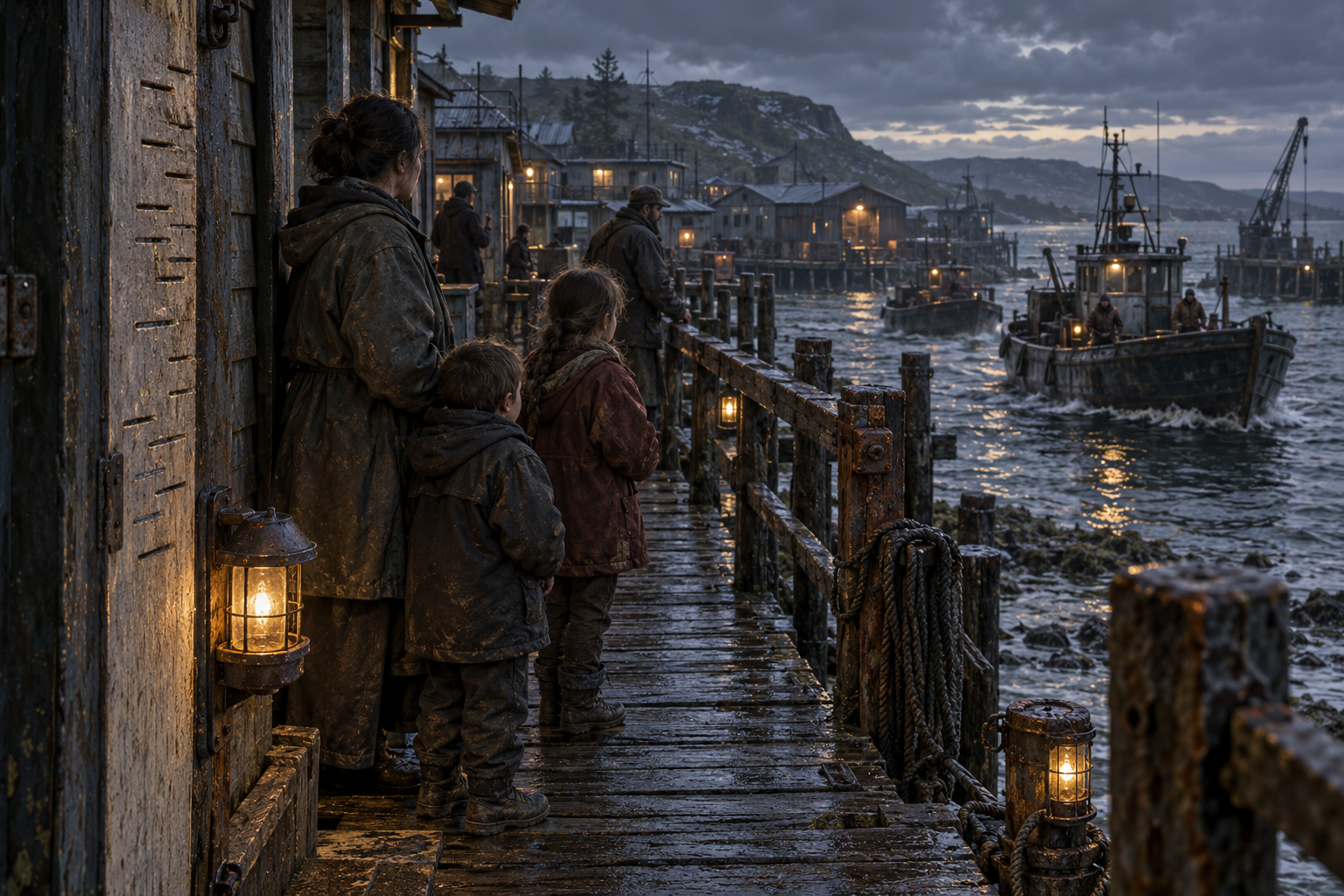
Coastal households keep flood marks on door frames and argue over whether a mark records a measurement or a grandfather’s enthusiasm. The Return Lamps observance sets sheltered lights at the landing for boats due home. It is devotional in some homes, a practical signal in others, and an excuse for children to remain outside late in nearly all of them.
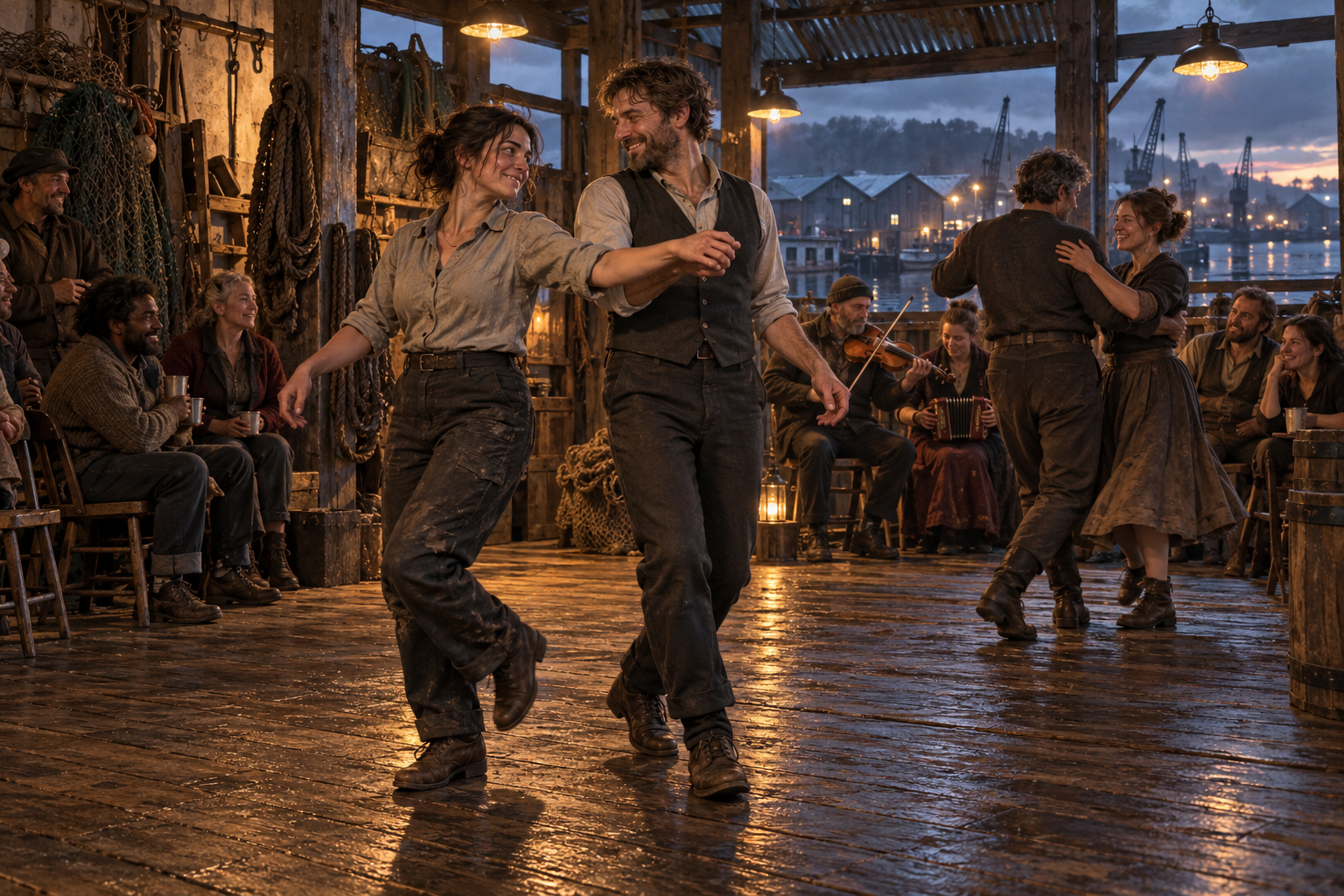
Musicians travel when a route can support food and a place to sleep. North Quay’s net loft is used for evening performances after the day’s work clears. Reedbank’s market sells information beside vegetables and repairs. A comic song can cross between the two faster than a formal correction.
Local radio and carried notices are useful but uneven. A notice signed by an official records what that office says; it is not proof that every promised service will arrive. The household letter has a different value. Istra’s letters to her daughter contain news she chooses, including the stool Baret made from sound offcuts when she thinks it interesting.
8. Works, skills and security
The coast maintains pumps, boats, small generators, radios and old drainage works through mixed expertise. Good salvage is valuable, but an unknown machine is not safe because it once had a purpose. Testing, isolation and understanding are work in their own right.
Spell practitioners use local knowledge and traded materials; adepts require training and limits. The coast has no universal public Research screen. Neighbours recognise demonstrated competence, reputation and failures they remember rather better than the practitioner would prefer.
North Quay has cranes, stores and a fenced runway beyond the southern built-up area. An airstrip is not a promise of a working shuttle or passage off-world. Local guards, hired security and the commissioner’s limited force serve different authorities. A road patrol cannot be everywhere, and moving it requires agreement over who remains protected.
9. Play and rest
Landing races reward balance and boat handling. Spectators place small wagers, and the distinction between an assisted start and an obvious shove occupies more discussion than the prize warrants. Children play ring-catch on dry boards; adults complain until invited to demonstrate how easily it should be done.
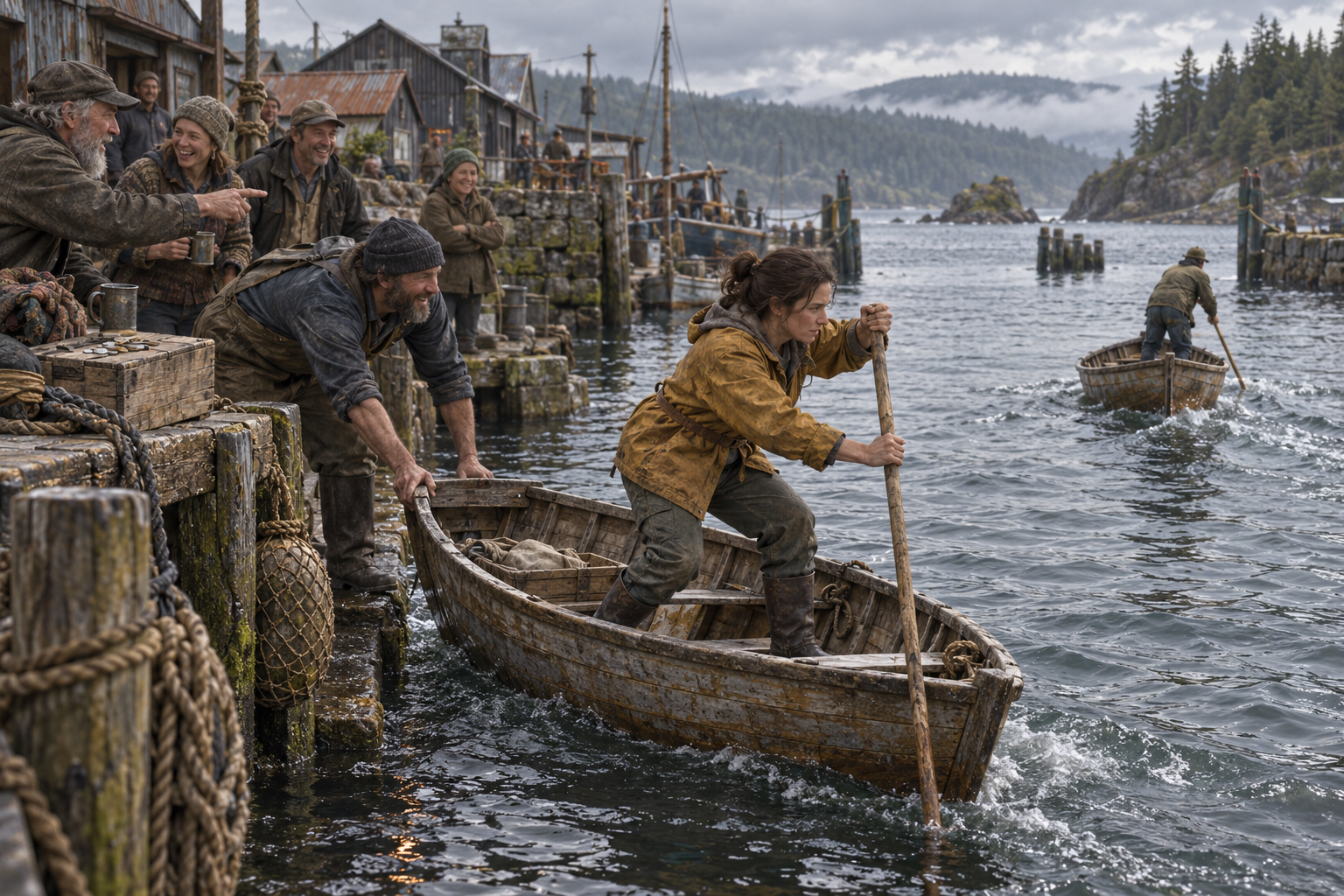
The Reedbank restday market includes food, music and repairs. North Quay’s evening net-loft dances draw loaders, clerks and visiting crews. A resident can enjoy a port’s entertainment while opposing its customs claim. Political sides do not determine every friendship, taste or dance partner.
10. Opening-year register and directory
The SR 682 coast register records repaired landing timbers at Moss Landing, a new shared rain gauge at Alder Hook and a season of disputed charges. The coastal petition remained unresolved at the opening of SR 683.
| Need | Where to begin | Limit |
|---|---|---|
| Customs account | North Quay guildhall and customs counter | Port interpretation is contested outside its accepted jurisdiction |
| Local deed enquiry | Settlement deed custodian | Bring copies; one office does not hold every original |
| Care in Reedbank | Surgery in the former school | Staff, supplies and capacity are finite |
| Boat repair | Repair bank below Reedbank’s houses | Istra’s workshop is one business, not the whole trade |
| Imperial treaty enquiry | Commissioner’s inland station | Restricted remit; travel conditions apply |
| Passage enquiry | North Quay carriers’ boards | A notice is not a booked berth |
Landings, debts and the shape of belonging
Along the Sedge Coast, a landing is a bundle of different rights. One household may own the shed, another the approach, while users share an older right to bring a boat alongside. The landing-rights charter of SR 527 made several such arrangements legible to distant creditors. It also made a neglected signature valuable enough to steal. Custodians consequently keep witness copies in separate settlements.
After a dispute over replacement piles in SR 641, several landing associations adopted paired maintenance books: one held by the keeper, one available to subscribing users. This was an agreement between participants, not a coast-wide law. It exposed some invented charges while creating profitable work copying perfectly genuine ones. A village outside the arrangement can still enforce its own agreement; it simply has fewer copies to lose.
A household without a deed
Seasonal fishers commonly rent a sleeping space and access to a hearth together. A room without cooking rights may be cheap enough to secure and too expensive to live in. Widowed fish smoker Cevra Dunn keeps a shared pot at Willow Brake, charging for fuel and ingredients separately. Her notebook contains settled accounts, unpaid accounts and the names of people she feeds without entering a sum.
Landing subscriptions buy specified services, not membership of a single coastal people. Newcomers can work for years without possessing a boat share or the kinship that makes an emergency loan possible. Some associations admit tenants as subscribers; others require an owner to answer for them. Local judges and witnesses hear disputes, but being free to complain does not replace the shift spent waiting to be heard.
The catch between the water and the buyer
Smokehouses, garden plots and repair sheds depend on imported salt, sound metal, fuel and medicine. Catch taken far from a buyer must be preserved before its price can be argued over. Fishers sometimes accept advances from smokehouse owners in return for the first offer on later catches. The written interest may be modest; the compulsory selling price can collect what the interest politely leaves behind.
Small producers share insulated boxes when they can obtain them, but reserve batteries and clean packing material are recurring costs. A box delayed at a landing holds food, tied-up money and somebody's next fuel purchase. Local mechanics maintain the pumps and radios that survive this trade. Offworld exports are a distant market reached through brokers, not a second economy hovering conveniently above the marsh.
| Seasonal pressure | Who bears the immediate cost | Useful local provision |
|---|---|---|
| High river and closed lower roads | Growers, boat owners and missed-shift workers | Raised stores, current landing notices and agreed alternative access |
| Heavy catches | Fishers unable to preserve or move them | Shared smokehouse time and separately priced salt |
| Failed pump or battery | Households furthest from a functioning supply | Repair subscriptions and tested reserve equipment |
| Long interruption in orders | Casual loaders and small repair shops | Small savings pools; assistance depends on available funds |
What lives at the wet edge
Siltjaws, thick-bodied fish with broad crushing mouths, shelter beneath submerged roots in the lower Sedge. Most feed on shellfish and carrion; large adults will bite a hand thrust into an occupied hollow. Netters work hooks from shore with long tools. Children learn the animal's pale barbels before they learn its market price. Its flesh is edible, but opening one beside drinking vessels is forbidden at several landings.
Pallid knotvine spreads across abandoned reed-cutting platforms, rooting through seams and hiding soft boards beneath waxy leaves. Its sap raises painful skin welts. Cutting it back without repairing the platform produces an exceptionally tidy trap. Coastal wardens distinguish this plant from ordinary binding growth that protects banks. Blanket clearance can leave a landing cleaner in the morning and undermined by the next hard rain.
Care, teaching and protection in small places
Roel's surgery in Reedbank and the High Bank infirmary cannot cover every inlet. Landing keepers hold lists of boats whose owners have agreed to carry an injured person, with costs settled afterwards where necessary. These lists record willingness, not permanent availability. Boat crews practise lifting a stretcher without tipping it; the patient has no duty to be grateful for an enthusiastic but untrained rescue.
Borrowed teaching rooms use old cargo labels for reading and broken scales for arithmetic. Coastal apprentices learn weather observation beside repairs, including when a trusted rule fails. Spellworkers preparing timber treatments must disclose what the treatment protects against. A psionicist cannot certify a storm harmless by feeling calm. Watches concentrate on stores, fire, violence and overdue boats; joint patrols require agreement rather than a claim that North Quay governs every road.
The lamps after the argument
Return Lamps require sheltered flame or a maintained electric light, somewhere safe to put it and somebody willing to watch. At Moss Landing, children paint small tin shields with fish, flowers and remarkably unflattering boats. Families reuse them until salt eats through the seams. People who believe the dead follow the lights stand beside neighbours who believe a visible landing is sufficient reason to keep one burning.
Restday food favours thick fish broth, fried garden roots and dark loaves that travel well. Musicians compete with the work of eating them. Landing races produce quick alliances: a customs clerk may cheer a Reedbank boat while his office pursues its owner for a disputed charge. No reconciliation is implied. Sometimes the clerk loses his wager, which provides the gathering with a more immediately satisfactory form of justice.