The plan shows named streets and selected properties on Old Town Bank and Rail Bank. Orientation and scale are indicative; property boundaries and contours are illustrative. No national boundary is shown.
Drag after zooming; use the controls or Ctrl + wheel. The directory also works by keyboard.
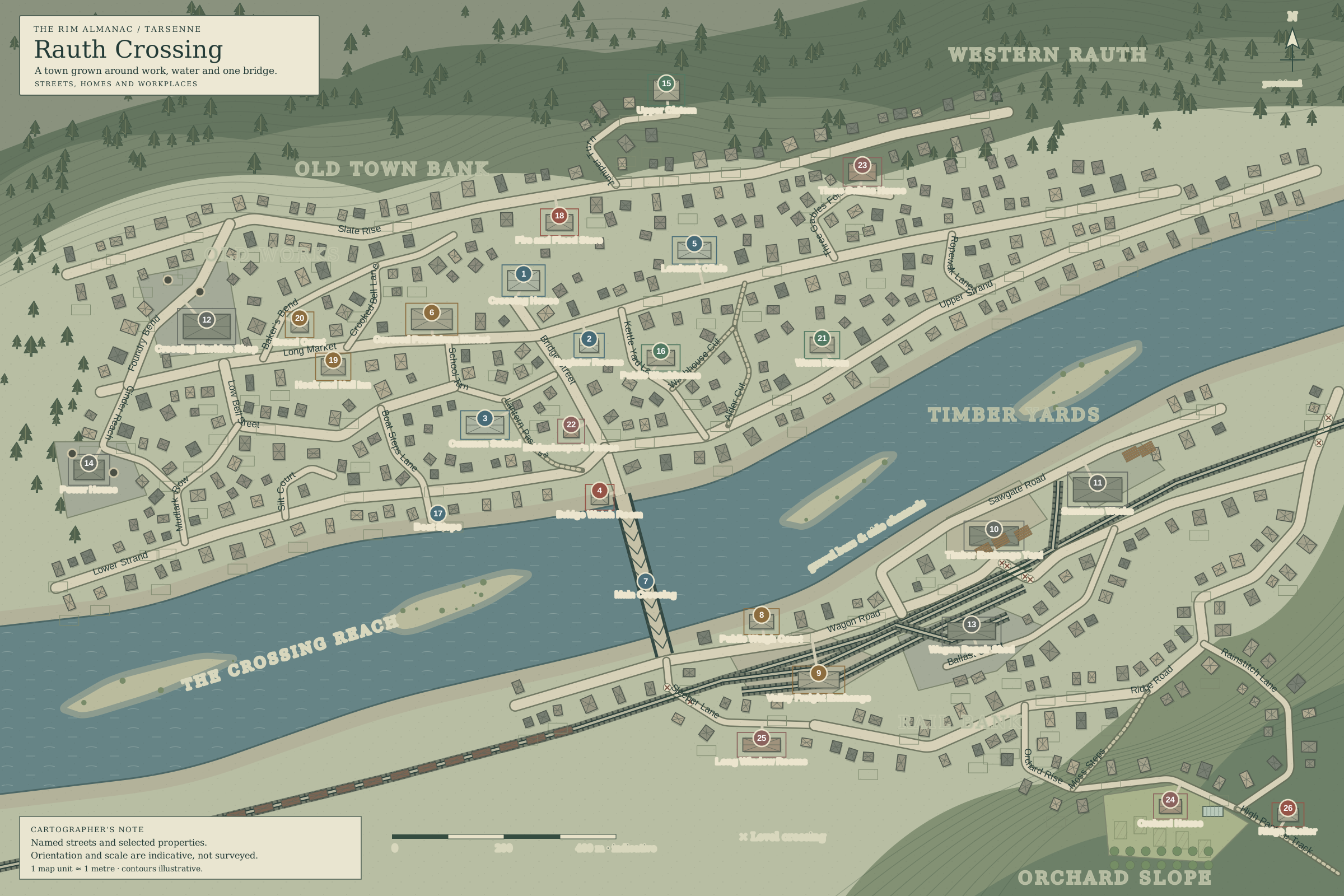
Landmark directory · 26 places
Street directory · 30 named routes
Rauth Crossing · detailed town plan
Zoom, pan, search named places and follow links between maps.
A town across two banks
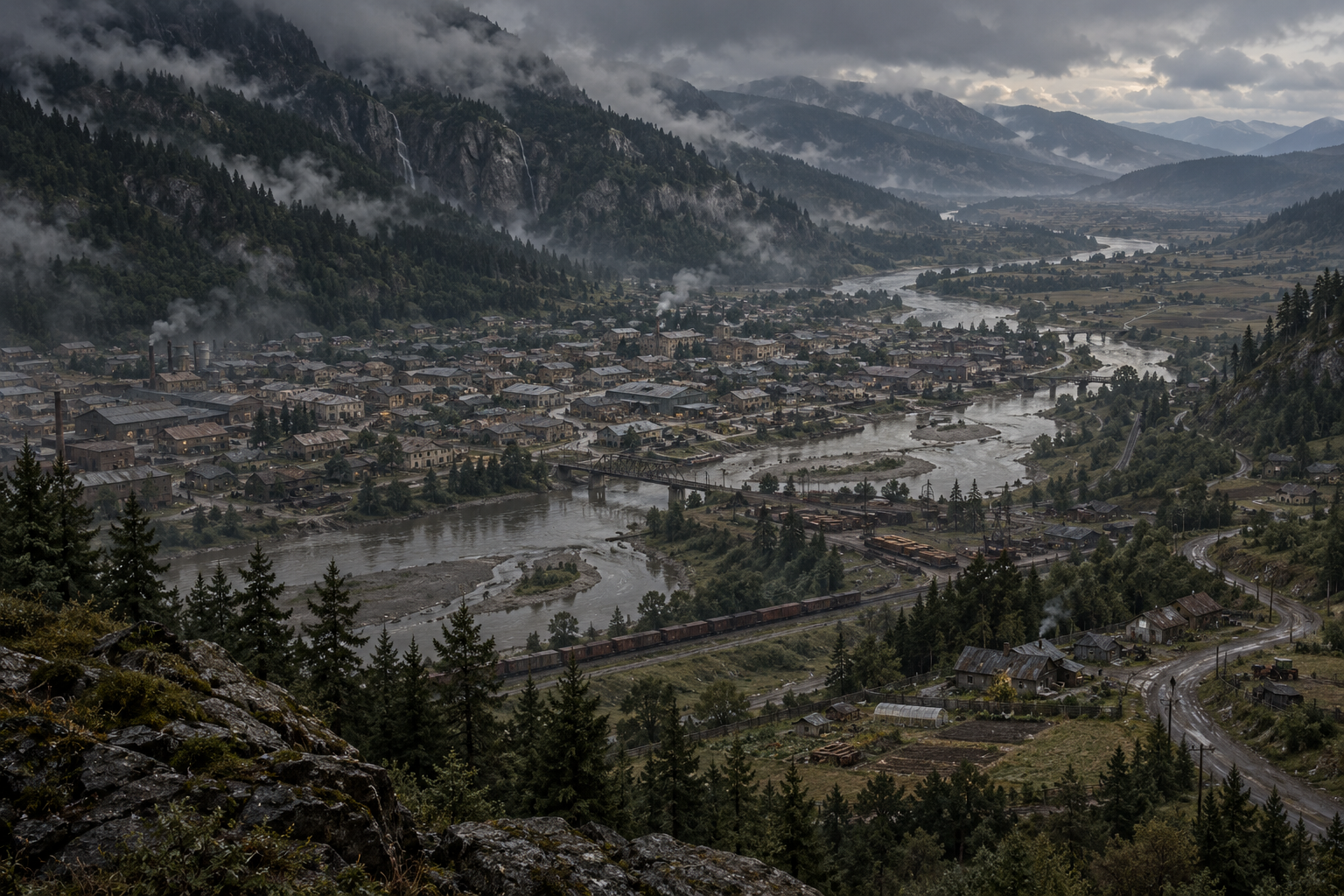
Rauth Crossing spreads beside a broad, winding river beneath wooded slopes, with low houses and workshops, rail freight, timber yards and a prominent crossing. The town spreads along the valley floor rather than climbing into a skyline of towers. Wet roofs, patched surfaces and machinery in use belong to the same landscape as gardens and inhabited rooms.
Old Town Bank contains the denser older settlement; Rail Bank contains freight yards and hillside homes. The plan uses these names to distinguish the two banks. Its orientation is schematic rather than a compass bearing.
Streets made by the town's growth
Long Market bends through Old Town Bank between older plots, while Bridge Street leads towards Main Crossing. Slate Rise follows higher ground; School Turn and Lantern Passage serve more local journeys. These streets turn around service yards, walls and inherited entrances. A short pedestrian route and a suitable delivery route need not be the same journey.
On Rail Bank, Wagon Road carries loads outside the freight sidings. Sawgate Road gives the timber premises a working approach, while Ballast Street serves Wagon Repair Shed and Sleeper Lane connects the exchange district with rented rooms. Public Weigh Court receives loads where they can be brought in and turned. Main Crossing joins the two banks within this plan; the map does not claim that no other bridge exists elsewhere in the valley.
Civil life between the yards
Crossing House and the Register Rooms give residents places to bring ordinary local business. Common School, Covered Provisions Market and Public Washhouse make the town useful to households as well as carriers. Lowbank Clinic occupies a raised terrace despite its neighbourhood name. The arrangement puts care within the town's street network without moving a treatment room onto the wet working edge.
Bread Court and the Hook and Nail Inn belong beside the industrial premises in the account of the town. People need meals before early work and somewhere to meet when a house is crowded. The Warm Room provides a shared indoor place without requiring its users to purchase a drink. Three Gables House, Orchard House and Long Window Rooms begin a residential directory. A place can be grim in bad weather and still contain a clean table, a repaired coat and someone pleased to see a familiar face.
The Upper Cistern, Boat Steps and Fire and Flood Store identify different practical needs. Water storage does not guarantee supply to every tap; river access does not make every bank safe at high water. Neither the town's local council nor the presence of industrial machinery establishes which larger state, if any, governs it.
Reading this map
Use the full-width plan to follow the named streets, inspect the numbered places and compare the two banks. The accompanying gazetteer describes their uses. Orientation and distances are indicative; the plan supplies no surveyed cadastral boundaries or guaranteed journey times.
The plan describes Rauth Crossing before Aveline’s departure. It shows a selected street network and individual premises, without assigning a national border or allegiance.
Three layers of the town
Rauth Crossing's earliest surviving accounts concern a landing, repair work and payment for maintaining passage across the valley river. They do not identify a single founding household. Old Town Bank grew through adjoining plots; lanes bent around occupations that were already earning money. Long Market's awkward line preserves that history more faithfully than a ceremonial avenue could have done.
The freight settlement on Rail Bank expanded after a group of yards pooled costs for a rail approach in SR 606. Timber handling and wagon work drew people to rooms near their shifts. In SR 655, Lowbank Clinic moved onto its present raised terrace while retaining the name patients knew. By completed SR 682 the two banks supported a common working town, whose debts, friendships and ordinary journeys crossed Main Crossing more frequently than its officials did.
Crossing House and the household ledger
Council business at Crossing House includes service charges, road access, repairs and contracts for common works. A contractor may be a major employer and still owe an explanation for a blocked drain. Public hearings require declarations of financial interests, but a room in which nearly everybody has worked for the yards cannot remove every connection. Recording a connection makes it contestable; pretending nobody has one leaves it in control.
Register Rooms records births, titles and agreements, including lodging statements that help newcomers establish where they actually live. Seasonal freight workers often move between beds without leaving town. Their need for a clinic, washing water and safe streets does not disappear between entries. Boarding-house keeper Halvenna Drenn of Long Window Rooms keeps individual receipts because collecting a week's rent should not require the payer to become invisible in a single household total.
The plank is not the finished product
Timber Exchange Yard grades incoming wood and keeps working strips clear between stacks. Sawframe Works needs sound blades, maintained guards, drying energy and reliable removal of waste. Rushing wet boards to sale moves the drying problem into somebody else's roof. Buyers seeking treated structural timber examine batch and seasoning records; a dark stain on a plank proves only that something dark has been applied.
Crossing Machine Shop on Foundry Bend repairs fittings, pumps and local plant, while Wagon Repair Shed opens onto its working siding on Rail Bank. Both depend on tools, lubricants and components from beyond the valley. Main Crossing and Wagon Road carry ordinary deliveries, with public traffic kept outside active sidings except at marked crossings. Local orders enter wider markets through carriers; the town's useful output does not grant any foreign purchaser ownership of its premises.
| Working address | Trade or service | A recurring pressure |
|---|---|---|
| Sawgate Road | Timber exchange and sawframe work | Seasoning space, blade supply and fire separation |
| Foundry Bend | Machine repairs | Worn tooling and parts awaiting delivery |
| Ballast Street | Wagon repair | Track access, spare assemblies and safe isolation |
| Sleeper Lane | Boarding rooms and freight households | Noise, shift hours and insecure tenancy |
| Kettle Yard Lane | Public washing | Fuel, clean water and enough drying space |
The valley keeps what the chimney releases
Still wet weather can hold smoke low among the roofs. Industrial heating, domestic stoves and reserve generation contribute in different amounts, so residents distinguish a smoky day from evidence against one particular chimney. Cinder Reach premises collect oily residues and metal-working waste separately; dumping them into rain drains turns a workshop's saving into a downstream bill. Acidic runoff is tested where battery work creates that risk, rather than assumed from the river's colour.
Threadmoth larvae tunnel beneath damp bark left too long against stores. Their pale workings weaken stock before an inattentive buyer sees damage. Drying, separation and inspection are more reliable than covering a suspect pile. Weedy vacant yards attract rats and scavenging dogs; fouled bites can become serious where treatment is delayed. The town is inhabited ground within living woods, not a sealed machine from which unwanted life can be permanently excluded.
A shelter has to remain reachable
The Fire and Flood Store on Slate Rise holds maintained pumps, ropes and emergency supplies. Bridge Watch Room staff manage incidents and closures, while trained neighbours and service crews provide much of the response. A blocked approach can strand useful equipment. Ridge Shelter is a civil refuge reached by High Pasture Track, with notices explaining access during bad weather; its existence does not guarantee that every exhausted traveller can reach it unaided.
Upper Cistern supplies depend on maintained collection and distribution. Public Washhouse gives households somewhere to wash without assuming each rented room has suitable facilities. Lowbank Clinic treats common illness and injuries, arranges difficult referrals and keeps work-related complaints where they can be compared. Psionic practitioners must state their actual service; material treatments receive ordinary inspection. Neither a warded machine nor an employer's confidence excuses leaving a guard off its moving parts.
Behind the long windows
Common School uses School Turn for deliveries and local foot passages for many pupils' journeys. Evening sessions teach reading, accounts and workshop drawing. Apprentices learn alongside workers whose lost fingers and scarred hands are evidence of preventable failures, not proof that every new pupil must suffer the same initiation. Families value skilled work while disagreeing about whether their children should remain dependent on it.
The Warm Room hosts reading, music and meetings without requiring a drink purchase. Threshold gatherings remember households who offered shelter during past floods; some participants address the dead and others chiefly repair the benches. Bread Court sells heavy loaves and onion pastries, while the Hook and Nail Inn serves stew to early shifts. Small frame-ball games fit cleared courts, and the hillside households around Orchard Rise trade seedlings. The town's pleasures use the same hands that are needed at work tomorrow.