Serrat · streets and landmarks
Zoom, pan, search named places and follow links between maps.
A capital above stored water
Serrat is the Sarthene imperial seat and a founding basin city on Damar. Its municipality contains an estimated 2.7 million residents; the wider commuting region holds roughly 4.1 million including those residents. The larger area includes other municipal jurisdictions, so a transport map and a voting register do not share one boundary. The city spreads through low civic complexes, residential blocks, workshop courts and freight grounds around managed water and older engineering works.
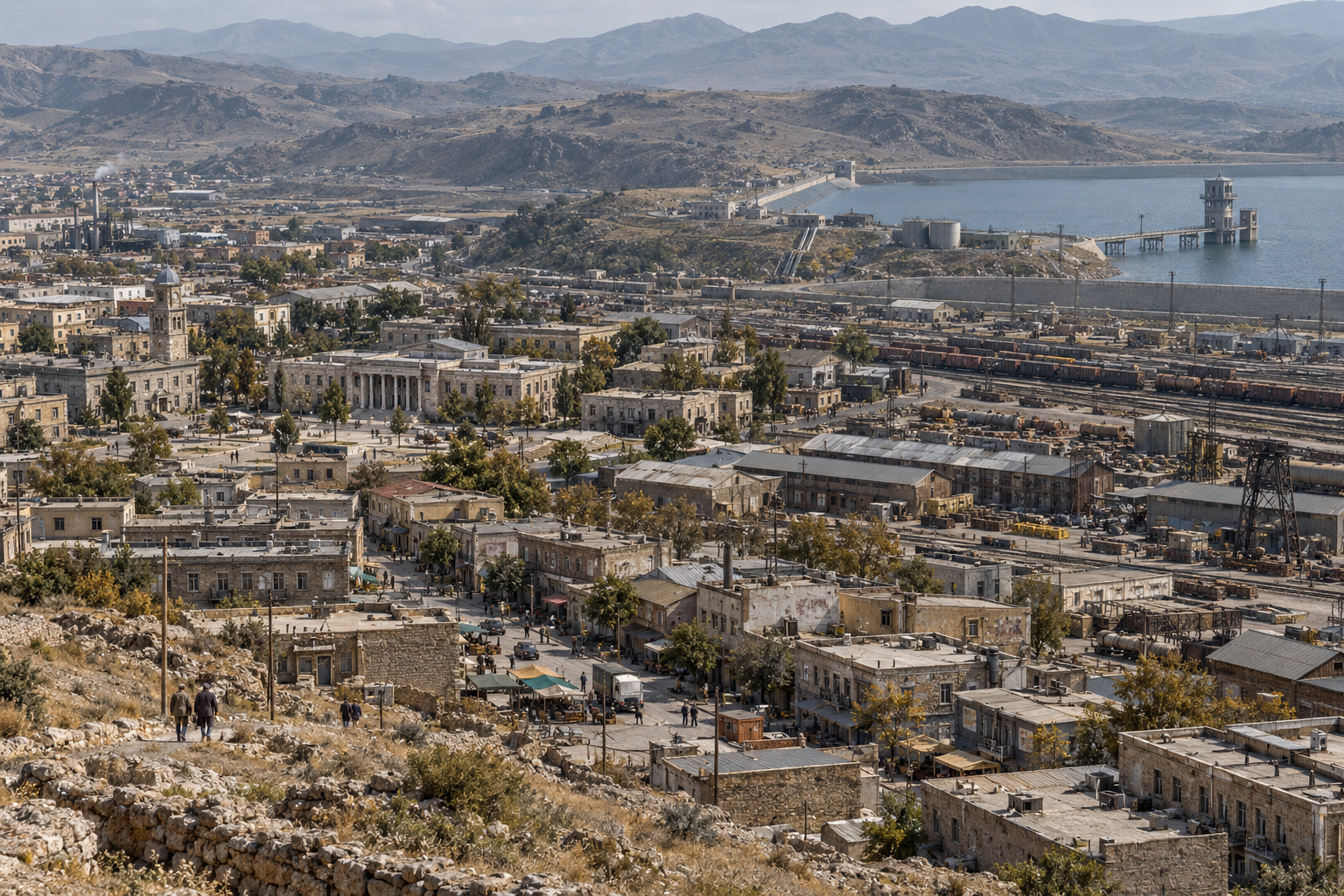
Reservoir terraces provide open public ground in some districts, while service reservations divide neighbourhoods elsewhere. A covered reservoir can support a carefully engineered garden; it cannot support any new building an investor considers attractive. Municipal permission requires structural and operational assessment. The Water Board's refusal to approve an ambitious project is often described as hostility to progress by people who expect to leave before the first repair bill.
Streets, courts and places to stop
Chambers Approach leads from the principal civic transport stops to Allocation Court, the older public records and hearing complex. Crown Terrace lies above and apart from it, carrying the imperial residence and associated public frontage. The Measure Court stands beside the civic-industrial transition, where Gauge Avenue carries commercial access towards calibration and instrument premises.
Porcelain Street joins the workshop quarter to Shade Market. Needle Court opens from the same commercial district into technical textile shops and ordinary repair rooms. West Transfer Hall receives regional passengers and lies beyond the busiest freight reservations, with supervised pedestrian approaches. Menders' Clinic is accessible from that passenger side, rather than through an active loading yard.
Old Reservoir Garden occupies protected public ground over a retired section of water infrastructure. Lower Aqueduct Walk follows the accessible edge below it, with barriers separating retained operational works. A useful route begins at West Transfer Hall, continues through Shade Market and Porcelain Street, reaches Gauge Avenue and Allocation Court, then climbs towards the garden. It describes connections rather than a guaranteed journey time for every pair of knees.
The city and the bodies meeting inside it
The municipality provides local services under Sarthene law. The Chambers of Cities deliberate here without becoming Serrat's municipal council; Emperor Ilyan's household and executive offices form further distinct employers and authorities. Demonstrators must therefore choose which entrance can actually receive their petition. Gathering before the grandest door may produce the best photograph and the least useful answer.
Serrat's established institutions benefit from the privileges of a founding city. Workers in nearby expanding settlements can commute into its workshops while their own municipalities possess weaker representation in the Chambers. Employers enjoy the labour pool and sometimes support reform. Others fear losing a familiar arrangement in which the cost of housing workers belongs elsewhere.
Municipal disputes include rents, neglected drainage, school capacity and accessible transport. The District Hearings Hall publishes decisions and provides translation services for recognised needs. Assistance is limited by available staff. Requiring an applicant to return with a better version of the same evidence is an efficient way to reduce a queue without solving a case.
Making accurate things under imperfect conditions
Instrument and calibration firms around Gauge Avenue supply civil works, laboratories, carriers and military buyers. Technical textile firms near Needle Court make protective fabrics alongside ordinary commercial cloth. Precision depends on controlled conditions, sound reference equipment and skilled staff. A city can possess a magnificent founding charter and still ruin a batch because a supplier delivered contaminated cleaning fluid.
The Measure Court maintains reference samples and independent acceptance facilities. Apprentices learn how to identify limits, record failure and avoid adjusting a result simply because the next stage of a contract depends upon it. Most errors are expensive without being dramatic. Some reach a pump, a clinical device or a vehicle before anyone understands why the paperwork looked so reassuring.
Trams, buses and regional rail carry workers. Freight uses dedicated approaches with scheduled delivery windows. Utility priorities protect critical medical and water functions during disruption, leaving lesser users to absorb interruptions. A small firm paying staff through downtime may fail while the authority's report correctly states that all essential services continued.
Care, classrooms and public belief
Menders' Clinic treats ordinary illness and occupational injury, with referral to larger hospitals for specialist needs. The surrounding neighbourhood contains older rental homes and small shops. Sevren and Amra live within this part of the city, close enough to use Old Reservoir Garden on a good walking day. Their ground-floor flat reduces one barrier without removing the cost of rent or the vulnerability of retirement income.
Schools, public libraries and technical institutes coexist with expensive tutoring. The city prizes articulate public argument, which can make an unfamiliar accent or a badly organised sentence seem like evidence against a perfectly sound complaint. Adult classes at the Allocation Library help residents prepare applications and understand notices without requiring them to become miniature officials.
Open Basin congregations and secular associations organise meals, memorial gatherings and practical assistance. They disagree about spiritual explanation while sharing some obligations. A public dedication can honour an engineer, a donor and a community in one ceremony. The workers who cleaned the site usually hear it from outside the reserved seating.
A city worth the argument
Shade Market sells pulses, preserved orchard produce, breads, hot dishes and household goods. Its covered edges are valuable in bad weather and consequently expensive to rent. Informal sellers gather outside the regulated frontage, negotiating toleration and risking confiscation. Customers who praise authentic street life do not always ask what its participants pay to remain there.
The city's theatres produce historical drama and sharp municipal comedy. Garden programmes offer free music; indoor courts and games clubs serve neighbourhoods through small subscriptions or public support. Young performers compete for space in a city that celebrates culture more generously in speeches than in rehearsal-room budgets.
During stagnant weather, smoke and industrial dust make some districts unpleasant and others dangerous for vulnerable residents. Parks and shade do useful work without curing exposure. Serrat's public beauty is genuine, maintained and politically distributed. People can admire it, argue over its cost and sit beneath it while deciding what they can afford to cook that evening.