Drag to pan · use + / − to zoom · arrow keys to move · Home to reset · select a numbered place. Ctrl + wheel also zooms.
Select a numbered place to read its purpose. The written directory below contains the same information.
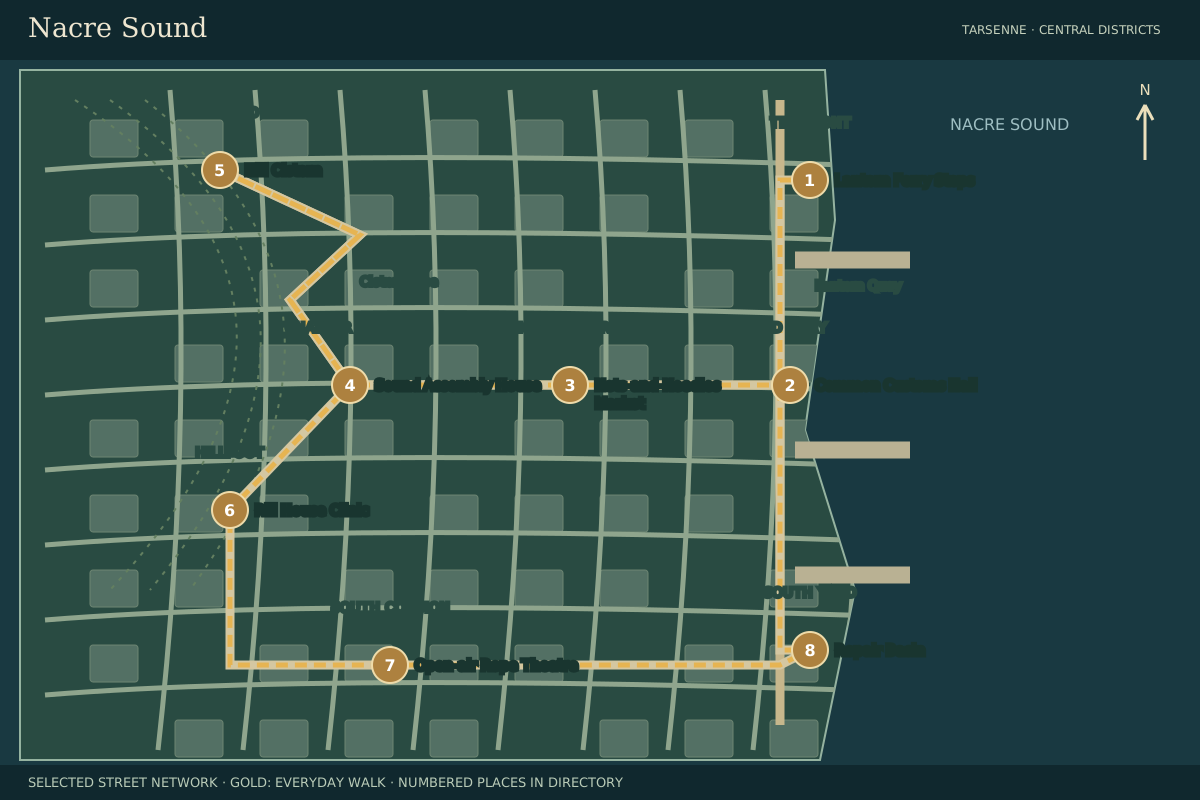
Nacre Sound · central streets
Zoom, pan, search named places and follow links between maps.
The city and its ground
Nacre Sound occupies the western shore of Aruvan’s sheltered eastern bay. The sea lies east of the built-up city; the inhabited hill rises to the northwest. Its name comes from the pale inner surfaces of shells formerly sorted beside the landing. Modern harbour mud has done little to preserve the advertised colour.
Municipal returns assembled for SR 683 suggest about 116,000 people within the continuous built-up area and roughly 185,000 in the wider district, including outlying villages. These rounded resident estimates are included within Veydan’s total. Ferry passengers and day workers are not additional permanent residents.
Old Quay is noisy, expensive and close to work. Middle Ward mixes rented rooms with shops and public offices. The northwestern Hill Ward is cooler but awkward for anyone who cannot manage steep streets. South Yard has repair berths, workers’ housing and the smell of hot metal after rain. Neither wealth nor deprivation follows a perfect contour line.
Eight places on the plan
The numbered plan shows district relationships and walking connections, not surveyed distances. All eight places stand on land west of the bay; the ferry steps and repair basin touch its shore.
| No. | Place | District | Why people go |
|---|---|---|---|
| 1 | Lantern Ferry Steps | Tidefront | Island ferries, arrival notices and covered waiting |
| 2 | Common Customs Hall | Old Quay | Cargo declarations and common-trade enquiries |
| 3 | Nets-and-Needles Market | Middle Ward | Food, repairs, cloth and daily household purchases |
| 4 | Sound Assembly House | Charter Square | Public sessions and federal petitions |
| 5 | Hill Cistern | Hill Ward | Water service office and the upper public terrace |
| 6 | Rill House Clinic | Hillfoot | Primary care and referral appointments |
| 7 | Open-air Rope Theatre | South Common | Plays, music and public gatherings |
| 8 | Repair Basin | South Yard | Vessel repair, buoy assembly and yard deliveries |
Two streets and an ordinary walk
Lantern Quay runs north to south along the waterfront, linking the ferry steps, customs hall and southern repair basin. Cistern Rise begins at the customs hall, climbs west through the market to Charter Square, then turns northwest towards the hill. Its upper road uses bends; the direct stairs are a separate, steeper pedestrian shortcut.
A visitor leaving the Lantern Ferry Steps follows Lantern Quay south to the customs hall, turns west into Cistern Rise, passes through Nets-and-Needles Market and reaches the assembly. Continuing northwest leads to Hill Cistern. Returning to Charter Square, a signed lane descends southwest to Rill House Clinic, then south to the theatre. The public path from the theatre runs east to the repair basin; Lantern Quay provides the return north.
That complete sequence is 1–2–3–4–5–4–6–7–8–2. It crosses no water. Crossing to another island requires boarding a ferry, checking the destination and paying or presenting an accepted concession. A line on the city map is not a promise of immediate passage.
What keeps the capital usable
Hill Cistern receives treated water from protected catchments and distribution works inland. Lower districts have public taps as well as household connections. Storm drains carry rain separately where the older streets have been rebuilt; mixed drains elsewhere remain an expensive problem. Waste travels to treatment works south of the occupied bayfront, with discharge monitored outside the bathing and intake zones.
The upper road can be tiring despite its switchbacks. Scheduled small buses and booked assistance connect the hill with the ferry. Tide differences make boarding geometry change through the day, and landing notices identify which ramp is usable. Emergency access lanes through the market are kept clear, sometimes through arguments audible at the assembly.
The repair basin makes coastal vessels serviceable and assembles navigation buoys from local and imported parts. Export consignments require booked freight beyond the city. The basin is not an interstellar ship waiting conveniently beside the theatre.
A late crossing
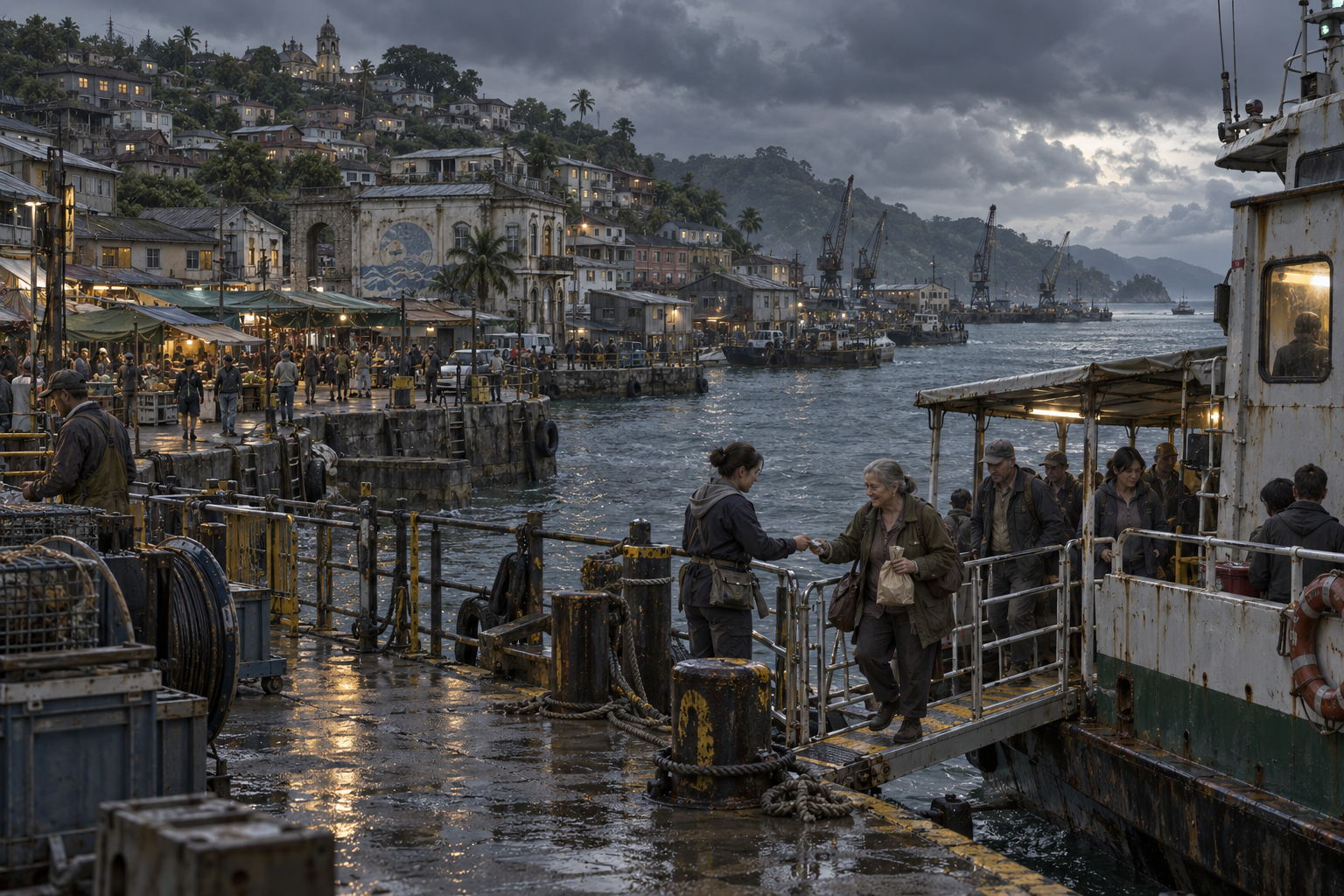
At the Lantern Steps, ticket clerk Mavessa Len recognised her aunt before the ferry sounded its arrival. Only one person on that deck sang the final line before the rest of the passengers had reached the chorus. Mavessa lowered the notice board she was carrying. Her aunt waved with a parcel that was leaking something through its paper.
‘It stayed dry until the landing,’ her aunt said. She offered this as praise for the voyage. Mavessa took the parcel carefully. Behind them, ropes tightened, the gangway settled and a child announced that the city smelled of dinner. Mavessa could smell diesel, wet rope and the pastry her aunt had sat on. She was glad of all three.
The bay before the assembly
Nacre Sound's shell-sorting landing preceded its common offices. The SR 419 settlement brought envoys, clerks, copyists and households supplying them; later ferry improvements enlarged the daily market. The common capital remained a city on Aruvan, not the proprietor of all seven states. Municipal repairs and federal salaries consequently appear in different accounts, though both can obstruct the same street.
Old Quay properties retain narrow plots inherited from waterside trades. Hillward growth offered cooler rooms at the price of longer journeys. Public offices increased the value of nearby rentals without improving every older drain. The city receives residents seeking work, schooling, treatment and somebody from home. Some arrive as citizens of the Concord and immediately discover how expensive belonging can be at an unfamiliar address.
Two offices behind a national name
Common Customs Hall handles matters within common competence; Aruvan's authorities retain relevant local powers. Traders need to know which charge they are contesting before the correct office can answer. The Hall keeps a public schedule of services, while unofficial intermediaries sell assistance ranging from useful translation to a highly polished explanation of why another fee is required.
At Charter Square, island petitioners can observe Assembly sessions without obtaining instant access to a minister. Lodging and missed work limit who can remain for a postponed hearing. A small rooms committee arranges shared accommodation for outer-island visitors, charging actual costs and refusing to certify their politics. Its organiser, Dernessa Vil, has hosted opposing delegations in adjoining rooms and learnt to label the breakfast shelves very clearly.
The yard beyond the public path
The Repair Basin's employment includes welders, fitters, buoy assemblers, cleaners and staff maintaining reliable power. Salt attacks unfinished work between shifts. Protected inspection rooms remain dry and clean while exterior structures require constant scraping and coating. A failed seal can return a buoy for repair; a neglected coating may consume a much larger piece of the yard before anyone budgets for it.
Kedran components reach Nacre Sound through booked island freight. Basin slots are assigned among ferries, local vessels, watch requirements and commercial orders. Workers can welcome an export contract while demanding that its deadline not erase rest or maintenance. Clinicians see the consequences of hurried lifting and repeated vibration. Municipal procurement pays for some better handling equipment; a foreman's decision to keep using the broken older device can defeat the investment.
| Neighbourhood | What draws residents | What complicates life |
|---|---|---|
| Old Quay | Work, ferries and customs business | Noise, rents and old drainage |
| Middle Ward | Markets, repairs and shared rooms | Crowded access and contested loading space |
| Hill Ward | Cooler nights and upper services | Steep travel and costly accessible rooms |
| South Yard | Skilled jobs and production | Salt exposure, industrial injury and shift hours |
The water above and below
Hill Cistern depends on protected inland collection and treatment, not on a fortunate position above the bay. Pipe faults in older neighbourhoods require opening crowded lanes; temporary supply points need room for carts and people unable to carry containers. Emergency service notices distinguish drinking water from supplies fit only for specified other uses. Giving both the same cheerful blue label would save printing and create considerable work for Rill House Clinic.
Storm myrtle on inhabited slopes holds soil but cannot compensate for careless cutting or blocked drains. Ghost-ladder vine can conceal cracked old terrace steps where maintenance has lapsed. The city posts closures at the actual approach as well as in offices. At the shore, landing staff choose usable ramps through the tide. A person waiting for assistance has a destination and a life beyond the waiting area, not an obligation to become somebody's uplifting story.
Learning, medicine and the night watch
Rill House Clinic provides primary care and referrals; complex treatment depends on the city's wider clinical services and available onward arrangements. Interpreters and visiting relatives often discover different understandings of the same instruction. Nurses verify what a patient has understood rather than treating a nod as completion. The Sound Institute's coastal disease work reaches ordinary homes through water testing, practical advice and evidence that can change a maintenance decision.
Schools and yard apprenticeships use common notices alongside island languages. Psionic tuition requires discipline and consent; practitioners do not settle cargo disputes by announcing a feeling about a captain. Local policing, common safety services and the maritime watch have separate responsibilities. Joint fire and evacuation exercises keep the market's emergency approaches open, while armed defence remains tied to actual port and maritime needs.
The passage someone chooses to prolong
Nets-and-Needles Market sells leaf-wrapped fish, terrace tea, sea greens and pastries whose contents travel less reliably than their hopeful wrapping. Keeping of Breath rooms host memorial gatherings within the city, alongside secular clubs and mixed family meals. Lantern Return brings relatives through the same steps used by tired workers all year. Mavessa Len's aunt can sing too early in the chorus without serving as a representative of an entire island.
The Open-air Rope Theatre needs sound rigging and a programme suited to weather. Wall-ball players on local courts negotiate evenings with neighbours; rowing clubs agree courses with harbour staff. Some people take a longer ferry to sit beside someone they like. Others sleep until their stop and are irritated to learn they have been praised for appreciating the view. Both have paid for passage, and neither owes the city a performance.