Halvyr · northern valleys
Zoom, pan, search named places and follow links between maps.
1. Identity and quick reference
Halvyr lies in northern Rauth, beyond the Sedge Coast's milder western valleys. The older Halven words behind its name refer to sheltered ledges: habitable ground above a river and below the worst wind. The name spread from several settlements to the crown that eventually joined them. The official emblem is a white branching antler above a copper-coloured lamp. Antlers signify the uplands; the lamp recalls the maintenance of public winter shelters. Neither is reserved to royal blood, and inns display versions considerably older than the present dynasty.
The reigning sovereign is Queen Sova Keldran. Rimefold is her principal seat and the meeting place of the Valley Estates. Halven predominates in public administration, alongside protected local speech forms and the trade language used across much of Rauth. Halvyr conducts its own diplomacy. Orinthian merchants may possess contracts there; their presence does not make the country imperial territory.
The civic motto is Leave a Lamp. Royal proclamations carry the Crown’s antler-and-lamp seal; ordinary inns may use the lamp but not pretend their bill is a royal writ. At formal observances the crown standard flies beside the host valley’s banner. The public song Shelter Enough began as a travellers’ chorus, and borough choirs still sing competing last verses. Winter Lights and the anniversary of the Valley Settlement are public rest days; pass crews receive their leave in rotation.
| Reference | Current entry | Coverage |
|---|---|---|
| Population | About 3.1 million | Resident estimate including remote valleys; mobile households imperfectly counted |
| Land | About 1.8 million square kilometres | Land area; fjord waters excluded |
| Capital | Rimefold | Royal seat and national administrative centre |
| Edition | Survey Reckoning 683 | Public period before Aveline's departure |
| Money | Halvyr mark | Ten small pieces to one mark; no fixed offworld exchange rate |
2. Geography, climate and living environment
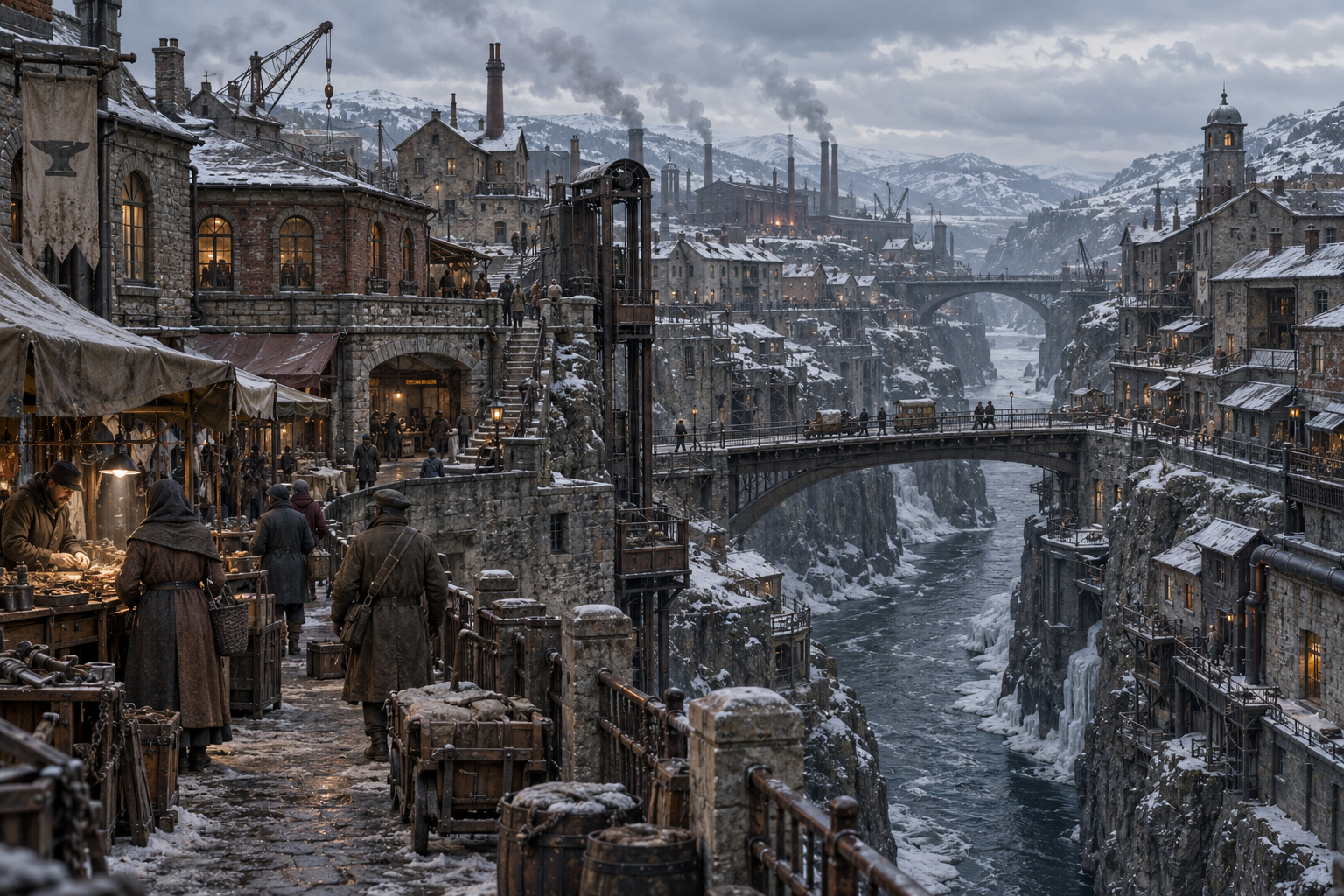
Western storms climb steep coastal mountains, leaving wet fjord forests and colder interior plateaux. Snowfall differs sharply between neighbouring valleys. A clear morning at a sheltered harbour tells a traveller little about the pass above it. The principal districts are the Brannic Fjords, the central Keld Valleys around Rimefold, the Lorn Plateau and the southern Vask approaches. Their boundaries follow administrative agreements as well as watersheds; a useful travel map shows both.
Fjord households gather timber, tend small livestock holdings and cultivate sheltered strips. The central valleys support denser settlements, root crops, glasshouses and workshops. The plateau contains extensive grazing grounds and stretches where no permanent settlement is sensible. Its mobile pastoral households use seasonal routes rather than wandering without a destination. They maintain rights to particular shelters, springs and repair yards.
Domestic architecture values an entrance where wet clothing can be removed before it reaches the living room. A household's outer vestibule may contain boots, drying racks, fuel accounts and three generations of unfinished conversation. Better homes have efficient heat exchangers. Poorly maintained rentals can be damp despite expensive fuel. Avalanche tracks, river ice and mould are different hazards, requiring different kinds of competence.
Cliff juniper binds exposed slopes, while copper larch thrives in sheltered upland pockets. Pale ridge goats graze above the managed woods; their seasonal routes cross human pasture boundaries without observing them. Fjord cloudbeetles emerge after the first sustained thaw and feed swifts nesting beneath old boathouses. Valley conservation courts protect breeding ledges and restrict timber cutting in avalanche catchments. Grazing households dispute closures that preserve a visitor’s view while removing their own winter fodder.
3. History and the documents people remember
The Shelter Pacts of SR 114 joined winter-route communities in an obligation to maintain stores for travellers. They did not establish a nation. Surviving accounts list blankets, food and labour beside arguments about people who arrived too often with empty packs. The Keldran house acquired influence through transport holdings, marriage and control of several protected crossings. Its eventual crown followed the campaigns of SR 276–283, when rival crossing lords lost toll rights and some settlements lost considerably more.
The Crown Covenant of SR 289 recognised valley courts and fixed the services owed to the monarchy. Copies survive with local additions. The Valley Settlement of SR 502 curtailed compulsory labour levies and created the Estates' present revenue powers. The two documents are not interchangeable. A royal festival may celebrate the Covenant while an upland household commemorates the later settlement that reduced what the Crown could demand.
After the prolonged grid failure of SR 661, emergency shelter inventories became public records and boroughs gained power to inspect contracted reserve stores. Sova inherited that system rather than inventing it. Her government is remembered in particular places through repaired substations and unpopular charges, not only through the dates in a royal list.
4. Government, law and current politics
Succession passes to the sovereign's eldest eligible child. Prince Eslan is the present recognised heir. A regency requires confirmation by the Valley Estates; neither a royal physician nor an ambitious uncle can create one alone. The Crown appoints national ministers and directs foreign affairs. The Estates consent to ordinary revenue and consist of borough delegates, valley representatives and a smaller hereditary bench. A vote therefore joins unequal forms of representation, a fact increasingly questioned in manufacturing towns.
Valley courts hear ordinary property and family disputes. Appeals concerning the Covenant go to the Crown Bench at Rimefold, where judges must give reasons independent of the royal household. The queen can exercise defined emergency powers to keep essential routes open, followed by review. She cannot convert that power into permanent ownership of a grazing route.
The sharpest current dispute concerns mobile households denied borough voting registration because they lack a single year-round address. Plateau delegates want route registers recognised as residence evidence. Several settled councils fear losing control of school and shelter contributions. Meanwhile, quarry owners seek longer leases near protected slopes. A voter may favour broader citizenship while opposing the particular road that would bring new work through her village.
5. Economy, labour, finance and trade
Halvyr exports precision metalwork, treated timber, cold-weather fabrics and preserved food. Fjord yards repair coastal vessels; inland shops manufacture pumps and components for difficult terrain. Selnic buyers purchase equipment in exchange for grain, salts and ceramic products. Contracts specify delivery points carefully. A consignment waiting below a closed pass has not necessarily reached the purchaser, however near it appears on a map.
Workshop employment mixes wages, family businesses and worker-owned shops. Larger employers bargain with trade associations over winter hours and injury support. Seasonal road workers are more precarious: the wages can be attractive while weather cancels the days on which they expected to earn them. Savings societies accept small deposits and provide loans against documented income. They also require guarantors whom newcomers may not possess.
The example below describes one winter month for two employed adults and a child in Rimefold. It is a constructed local account in marks, not an average wage or a promise that every family can save. The household uses public schooling, rents a modest flat and has no outstanding loan. A broken heater would consume its reserve.
| Illustrative thirty-day account | Marks | What it represents |
|---|---|---|
| Combined take-home wages | 260 | Income after payroll deductions |
| Rent | 48 | Two-room flat |
| Food | 82 | Bought food; no household plot |
| Heat and light | 34 | Winter consumption |
| Water and household service dues | 22 | Charges outside payroll |
| Local travel | 12 | Passes and occasional rides |
| Clothing, school materials and repairs | 26 | Uneven costs put aside monthly |
| Uncommitted reserve | 36 | Balance after listed expenditure |
6. Population, education, health and welfare
Most people live in connected valleys and fjord settlements, although the sparsely inhabited plateau occupies much of the map. National population estimates combine local registers, school rolls and negotiated counts of mobile households. They undercount workers moving between employers and should not be quoted to the last person. Extended families often live in adjoining homes rather than a single building. Unrelated adults also form registered winter households to share rent and heating.
Schools teach literacy, practical mathematics, regional history and environmental safety. Older pupils may travel to borough colleges or use recorded lessons supported by visiting tutors. A child on a seasonal route can keep a portable education record, although the quality of visiting provision varies. Apprenticeships exist in trades, care, administration and performance as well as engineering.
Borough clinics treat common injuries, respiratory illness and complications of cold housing. Rimefold has specialist surgery and rehabilitation, reached by scheduled transport or urgent evacuation when conditions permit. Care funds combine taxation and employment contributions. A remote patient can qualify for treatment yet struggle to arrange accompanying care for a child. Local shelter societies help with that gap, sometimes generously, sometimes according to old grudges.
7. Culture, arts, faith and communication
Halven praise often attends to endurance, but people also admire extravagance done well. A feast may place an absurdly delicate sugar sculpture beside a stew cooked to feed everyone twice. Rimefold's puppet theatres perform romances, historical arguments and grotesque accounts of royal incompetence. Puppets can lose a head for treason and have it sewn on for the next show. The audience usually considers this the principal advantage of their profession.
The Hearth Witness tradition treats maintained shelter as an obligation between living households and their predecessors. Some congregations understand the witnesses as present spirits; others preserve the duties without accepting that belief. Coastal shrines instead emphasise departure and return, and neither tradition contains every household. Marriage, naming and mourning practices vary between valleys. Public law recognises several forms without requiring one priesthood to certify them all.
Quarter festivals follow Tarsenne's seasonal turning, with the northern cold season occupying different quarters from southern Orsala. Local networks carry weather reports, drama and arguments from the Estates. Disconnected valleys still receive stored broadcasts and printed notices with transport. Travellers from elsewhere on the rim often learn the chorus of a local song before discovering that their host's valley finds its final verse insulting.
The poet Havren Dul’s Winter Guests remains widely memorised: its chapters follow four households offering shelter to the same unreliable traveller, whose story changes with each meal. Crown House owns an early illuminated copy. Market editions include illustrations in which the traveller increasingly resembles whichever minister has recently proposed a new charge.
8. Knowledge, infrastructure, powers and defence
Hydroelectric installations, storage systems and district heat networks serve the populated valleys. Backup generation and reserve fuel remain necessary when ice, mechanical failure or damaged lines isolate a district. The School of Measures in Rimefold trains surveyors, technicians and instrument makers. It keeps failure reports as teaching material; an elegant design that cannot be repaired locally earns little admiration there.
Psionic adepts train through several small schools and recognised teachers. Work involving another person's perceptions requires consent except under narrowly defined emergency law. Alleged impressions are not automatic proof in court. Concentration and mental strain limit what a practitioner can do. Spellworkers maintain local traditions of protective marking and material preparation. A treated hinge may resist icing longer; it still needs inspection, fresh materials and a responsible mechanic. No civic service assumes unlimited mana or universal access to private interfaces.
The territorial guard combines regular companies with trained valley reserves. Its priorities are crossings, stores, communications and evacuation. Coastal patrol vessels monitor fjords; air crews move supplies when weather allows. The monarchy maintains offworld purchasing contracts for certain components but possesses no public fleet offering passage to any citizen who asks. Halvyr's independence on the rim is defended through alliances, preparation and the cost an aggressor would pay for holding its routes.
Selected workshops sell strategically useful products to Orinthian purchasing agents as well as domestic customers. A contract transfers specified goods, not the workshop's sovereignty. Export lots travel through coastal brokers when freight capacity is booked; neither an imperial order nor a military specification creates an immediate departure.
| Named centre | Product and uses | Required inputs | Route | Buyers and authority | Bottleneck |
|---|---|---|---|---|---|
| Meraft glassworks, Keld Valleys | Optical blanks for surveying and military sights | Local silica, Selnic salts, imported polishing materials | Road to Rimefold, then Brannic coastal brokers | Domestic makers and limited Orinthian contracts; Halvyr jurisdiction | Skilled polishing and rejected batches |
| Rope Hall cooperatives, Rimefold | Cold-rated instrument housings for vehicles and field equipment | Regional metal, imported seals and storage components | Regional depots or booked coastal export lots | Civil repair firms and defence purchasers; sale of goods only | Precision fittings and winter transport |
| Brannic fjord timber yards | Seasoned structural timber for boats and protected installations | Managed forest harvest, treatment salts and drying energy | Coastal freight from contracted yards | Local yards and external construction buyers; harvest limits apply | Seasoning time and sustainable cutting quotas |
9. Sport, recreation and the uses of free time
Winter skating on supervised basins, summer ridge walking and competitive climbing draw organised clubs. The most popular team game, ring-carry, requires players to pass a padded hoop through movable gates while opponents obstruct with their bodies but may not seize clothing. Indoor leagues continue when outdoor surfaces are unsafe. Borough teams inspire loyalties that do not reliably follow political borders. The queen's attendance at a match rarely persuades supporters to forgive a bad referee.
People who dislike organised exertion have other options: public baths, storytelling rooms, model workshops, card circles and music over late breakfasts. The winter light festival invites neighbourhoods to make illuminated figures from reusable frames. Elaborate private displays compete with collective ones made from borrowed parts. Some families watch from warm rooms and call that participation.
Access costs matter. A nearby footpath can be free while suitable boots remain expensive. Schools and clubs lend equipment, and rescue services resent visitors who mistake assistance for a guarantee. Quiet recreation belongs in the record too: sorting seeds, keeping a window garden, courting on a covered bridge or sitting beside somebody who does not insist on conversation.
10. SR 683 review, references and directory
The present review records a functioning independent crown with unresolved electoral and resource disputes. Population and land estimates are rounded from the Crown Survey Office's regional summaries. The household account covers one household and is not a national statistical series. Information from valleys with interrupted transport may be older than the title date on a collected report.
A traveller needs the current pass report, permission for protected routes where applicable, and a plan for delay. A royal letter does not thaw a bridge. Residents commonly consult local offices first because those offices know which road, surname and promise an enquiry actually concerns.
The completed SR 682 record includes the reopening of Brannic’s public slipway after two seasons of reconstruction, the first shared equipment store for three plateau school circuits, and the winter publication of reserve inventories from the remaining unreported depots. These were practical gains. The open SR 683 argument concerns who funds their continuing operation, particularly when a school circuit crosses a borough boundary.
| Office or reference | Location or reach | Use |
|---|---|---|
| Valley Estates record room | Rimefold | Revenue decisions and membership records |
| Crown Bench registry | Rimefold | Charter appeals and published reasons |
| Winter Route Service | Regional depots | Pass reports, shelter access and rescue notices |
| School of Measures | Rimefold | Technical training and instrument assessment |
| Shelter Pacts; Crown Covenant; Valley Settlement | Local and capital archives | Different obligations established in SR 114, SR 289 and SR 502 |
The shelter bill after the traveller has gone
The Shelter Pacts made survival a shared obligation, but the means of paying for it remained local. Surviving SR 114 accounts distinguish food used by travellers from stores lost through a keeper's neglect. Later royal officers tried to combine them under wastage. Valley courts resisted: a hungry stranger and a leaking roof were inconvenient for different reasons, and charging both to the keeper concealed who had failed to supply repairs.
After the grid failure of SR 661, public inventories brought improvement and a new kind of evasion. Contractors sometimes delivered acceptable stores close to inspection and removed them against another account afterwards. Current depot practice records withdrawals as well as deliveries. Winter Route Service examiner Arven Mesk compares seals, dates and actual contents. He has never accepted a photograph of fuel as a substitute for fuel.
People whom a fixed address fails
Lorn Plateau route households mark family events at shelters, grazing grounds and particular springs. Their children may return to the same teacher by a different seasonal path. A borough register that accepts only a numbered house converts such familiarity into doubtful residence. Plateau delegates seek recognition of route records without placing every household under a headman's signature. Otherwise a reform advertised as inclusion can give a local patron a valuable new veto.
Marriage and household registration are separate arrangements in several valleys. Unrelated workers register a winter household to share heat and liability, then leave in spring. A partner who supplies most unpaid care may possess little of the registered income. Advice rooms attached to borough clinics explain property and support claims. The queue contains respectable people discovering that respectability does not specify whose name is on the stove loan.
Good glass, bad air
Meraft's optical blanks begin with sorted silica, controlled furnaces and compounds whose impurities matter. Clean finishing rooms and paid inspection are production necessities. Sulphurous fuel used by older auxiliary furnaces can produce acidic deposition close to poorly controlled works; collectors test rain and surface runoff there. It is a local industrial problem, not the ordinary state of every northern snowfall. Growers downwind notice damaged leaves before a quarterly report reaches Rimefold.
Rejected blanks can serve less demanding uses only after suitable assessment; disguising a rejected sighting blank as a medical component is fraud, not thrift. Workshops must pay for waste handling and ventilation while buyers press for lower unit prices. Qualified inspectors gain bargaining power from the difficulty of replacing them. Apprentices gain that power much later, after years in which a family must help pay for transport, rent and the time spent learning.
| District | Essential work | Dependency beyond the district | Pressure on households |
|---|---|---|---|
| Keld Valleys | Optical glass and instrument workshops | Selnic salts and specialist polishing material | Rent, training costs and pollution near older furnaces |
| Brannic Fjords | Seasoned timber and vessel repair | Treatment compounds and dependable drying energy | Seasonal wages and restricted cutting grounds |
| Lorn Plateau | Grazing and maintained seasonal routes | Grain, clinical supplies and replacement equipment | Distance, shelter dues and disputed residence evidence |
| Vask approaches | Transport, storage and road repair | Open passes and sound vehicle components | Interrupted shifts and expensive delay |
The living mountains are not scenery
Slate cats hunt ridge goats along broken ground above the managed woods. Their mottled coats disappear against scree; people most often encounter their tracks beside a carcass they should leave alone. Livestock enclosures and travelling in company reduce trouble. Paying a bounty without recording where an animal was taken encouraged the killing of harmless valley cats, so several districts now require evidence assessed by a keeper.
Felt-root fungus grows beneath damp floor linings and stored insulation. Its pale mats resemble useful packing until disturbed; spores irritate damaged lungs. Landlords can lower a room's visible damp by repainting it while leaving the infested cavity untouched. Borough clinicians record these cases alongside heating failures. The resulting disputes are about building work and money, even when a tenant's relatives describe the house as having acquired a malign appetite.
Who carries the reserve
Territorial service takes people away from shops, herds and caring work. Valley reserves arrange exercises around essential seasonal labour where possible, but not everyone can shift a wage. Employers claiming compensation must record the actual absence. A reserve member can face resentment both for leaving and for returning to a job another person kept alive.
Clinical transport shares vehicles and routes with ordinary freight; the value of a specialist appointment depends on arriving. Schools of psionic discipline lend access to supervised practice rooms, but a certificate does not authorise intrusion into another person's perceptions. Hinge wards and cold treatments consume materials and skilled attention. The School of Measures tests their claimed performance beside untreated samples. A winter shelter worthy of trust keeps blankets even when its protection marks are new.
The second verse at a warm table
Hearth Witness congregations disagree about whether assistance creates a sacred debt. Some record the recipient's name for later remembrance; others deliberately omit it to prevent public humiliation. Both can serve the same thick barley-and-root stew. A newcomer learns which custom is in force by watching whether guests are asked to speak before being given a bowl.
Smoked cheese, preserved berries and dark bread travel into houses where elaborate festival sweets would be crushed. Ring-carry clubs repair their own gates; bathhouse musicians perform on afternoons when steam makes tuning miserable. Havren Dul's unreliable traveller appears in school recitations and adult puppet farces, useful to a country that admires endurance while remaining deeply suspicious of being asked to endure on somebody else's behalf.