Drag to pan · use + / − to zoom · arrow keys to move · Home to reset · select a numbered place. Ctrl + wheel also zooms.
Select a numbered place to read its purpose. The written directory below contains the same information.
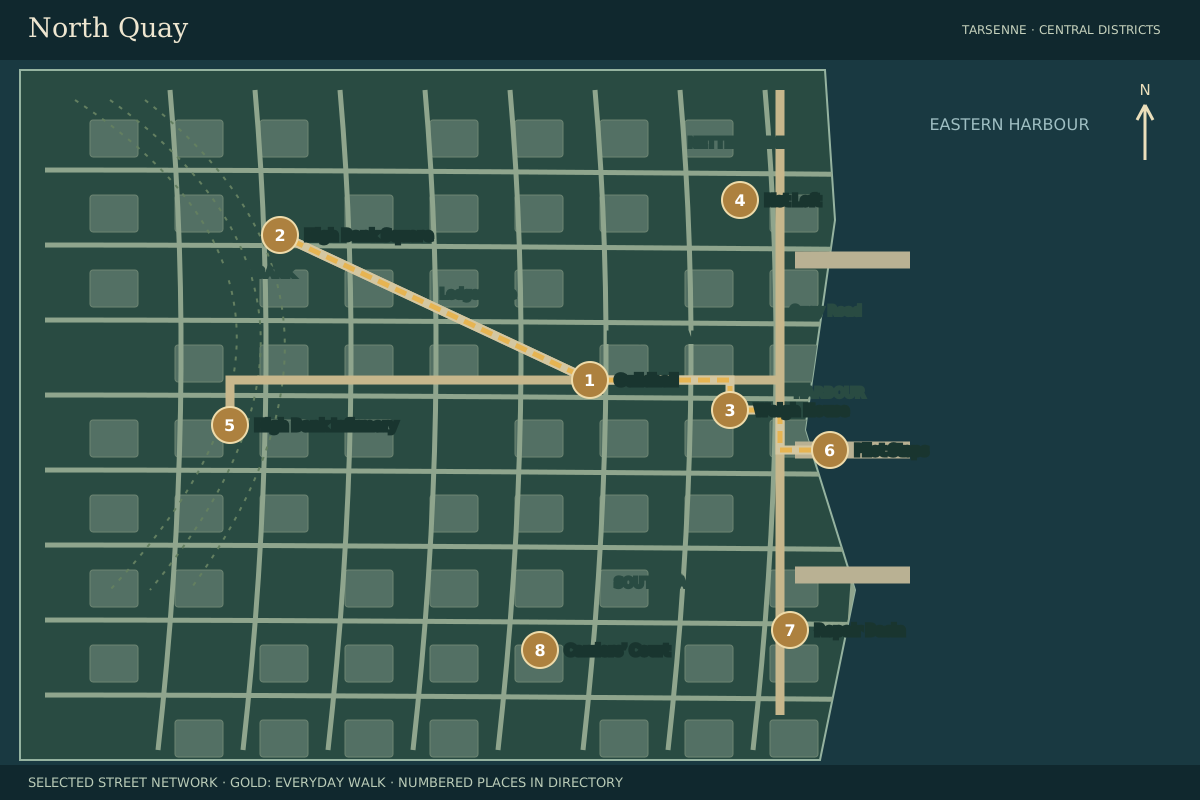
North Quay: city and harbour · central streets
Zoom, pan, search named places and follow links between maps.
The shape of the port
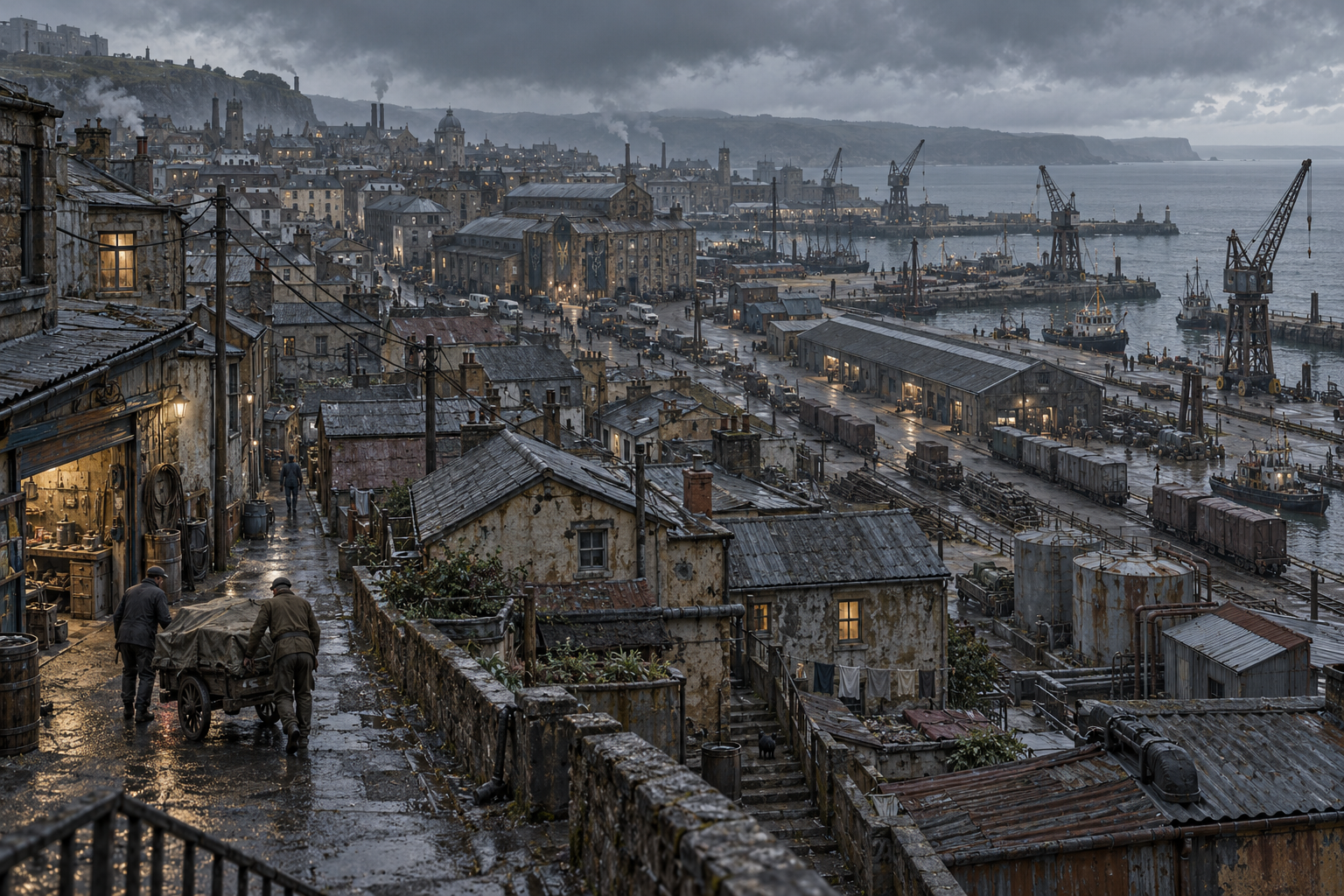
North Quay’s plan places the harbour to the east and the high bank to the west. The port developed along a narrow shelf above the working water. Behind it, older paths climb towards houses, gardens and drier stores. New freight yards occupy the southern approach where land is flatter. A fenced runway lies farther south, outside the street plan.
About 21,000 residents live in the built-up port, counted separately from the farms in the wider Sedge Coast district. The plan covers its central neighbourhoods rather than every outlying house.
Cottages in the upper lanes have better drainage and inconvenient access. A freight worker with sore knees may prefer a lower room near the shift bell, even knowing which storms push water under its door. Height matters without being a perfect diagram of wealth. Some old upper houses are subdivided; some waterfront offices keep expensive floors.
Streets and districts
Quay Road follows the harbour north to south. Ledger Rise climbs west from the guildhall towards High Bank Square. The two form the easiest landmarks for a newcomer: along the water, or up from it. The freight spur enters the southern yards; it does not run through residential courtyards. Harbour Lane and Net Street serve the northern shops and working lofts.
The map distinguishes High Bank, Ledger Ward, Netters’ End and South Yards. These are neighbourhood names, not four separate councils. The port watch keeps its harbour room beside the working quay. The infirmary sits on the high shelf, accessible by a long ramp from Ledger Rise; the shortest stair route is unsuitable for carrying a patient.
Eight places to find
Numbers on the plan identify public destinations and working landmarks. Private homes occupy the blocks between them.
| No. | Place | District | Why people go |
|---|---|---|---|
| 1 | Guildhall | Ledger Ward | Council chamber, witnessed transactions and public hearings |
| 2 | High Bank Square | High Bank | Upper market, gardens and the inland road |
| 3 | Weigh House | Ledger Ward | Cargo scales and a separately recorded receipt |
| 4 | Net Loft | Netters’ End | Day work; performances and dances after clearance |
| 5 | High Bank Infirmary | High Bank | Treatment, small ward and dispensary |
| 6 | Pilot Steps | Harbour | Local pilots, tide notices and passenger boats |
| 7 | Repair Basin | South Yards | Hull work, stores and loading machinery |
| 8 | Carriers’ Court | South Yards | Freight offers, road wagons and departure boards |
Water, waste and a route uphill
Covered cisterns above High Bank receive tested upland water. Separate drains carry runoff down the slope. The lowest lanes use holding tanks whose emptying is a paid service, one that poorer owners can postpone to everybody’s disadvantage. Repairing a drain does not settle who pays for it.
A visitor leaving the Pilot Steps reaches Quay Road, passes the Weigh House and turns uphill beside the Guildhall into Ledger Rise. High Bank Square is the end of that climb. The map’s gold route follows this sequence; the infirmary’s ramp branches farther west. It is a useful walk, not a promise that crowds, weather or a heavy load will take a fixed number of minutes.
A lunch carried carefully
Mave Tir carried her father’s lunch from High Bank in a jar wrapped in a faded scarf. He had asked for stew without the small white roots. Her mother had put in fewer roots, which was the compromise available in their house.
At the Weigh House she stopped to let a handcart pass. One wheel struck the kerb and the sacks shifted. The loader swore at the wheel as though it had applied for the job under false pretences. Mave moved her jar to the other hand. From the Pilot Steps came the thin music of a whistle being practised badly, with considerable commitment.
Her father was waiting outside the Net Loft. He accepted the jar, lifted its lid and considered the surface. Mave watched him count the roots. He looked at her; she looked at the harbour. After a moment he handed her the bread he had saved from breakfast. They sat on the dry end of a rope crate until the shift bell rang.
Access and departure
The upper road leaves towards the inland ridge and the commissioner’s wider station district. The coast road and runway approach leave south. Neither is an interstellar route by itself. A traveller still needs a functioning vehicle, a carrier’s terms and a destination willing to receive them.
The city map offers zoom, pan, a highlighted everyday route and numbered places with written descriptions. It records the opening reference period. It does not reveal the outcome of the coastal hearing or later damage.
The port built around its receipts
The oldest landing plots survive as narrow frontages around Netters' End. Deeper-water business brought warehouses and the Weigh House closer to the central quay; later freight expanded south where wagons had room to turn. A warehouse fire in SR 612 destroyed several roofed stores without destroying their mortgages. Rebuilding left wider service gaps in Ledger Ward and a durable argument about whether a firebreak was taxable floor space.
Council minutes after the SR 527 charter distinguish harbour maintenance from charges asserted over independent landings. Later leases blurred the distinction without dissolving it. The Guildhall keeps copies of these instruments because almost every faction expects an old sentence to become useful. North Quay's residents are not all beneficiaries of the wider customs claim: renters can pay higher food prices while the additional revenue services obligations they never negotiated.
Power on Quay Road
Port councillors authorise expenditure; harbour officers decide whether a berth is usable; warehouse creditors can refuse the release of pledged goods. None possesses the others' entire authority. The Harbour Debts Room, a counter within the Guildhall, records contested charges separately from admitted balances. That distinction can prevent a premature seizure, provided the owner reaches the counter before the carrier's departure.
Cargo examiner Neris Pell became unpopular with two competing firms by retaining photographs of damaged seals. She also has a brother employed by one of them and declares the connection on his company's cases. The declaration does not make her infallible. It gives a complainant something more useful than gossip to ask the council about. Local watch officers serve port law; Commissioner Sorn's limited remit does not make them his private force.
Rooms by the shift bell
Netters' End rents beds by the week, sometimes by alternating occupancy between shifts. South Yards lodging houses offer closeness to work at the price of exhaust, clanging chains and sleep broken by freight. High Bank has crowded subdivided houses as well as comfortable ones. A loader may spend the difference between two rents on the bus needed to reach the cheaper room.
Lodgers' associations pool money for witnesses, drain complaints and funeral contributions. A tenant whose name is absent from the main household return can still be known by half a street. Children in mixed crew households hear several dialects; schoolrooms use coastal trade speech while accepting home-language reading groups when teachers are available. Breakfast stalls selling broth and oat cakes keep early pupils fed alongside workers finishing their night.
Industrial weather and the useful machine
Repair Basin workshops clean hulls, mend lifting gear and machine straightforward replacement parts. Their limits arrive in crates: bearings, seal stock, electrical controls and reliable medicine come from elsewhere. The freight spur serves South Yards and booked regional movements. It neither carries every Tarsenne export nor promises an interstellar connection. The fenced runway's occasional activity can be heard much more often than a passenger seat can be bought.
Still mornings trap engine smoke against the western bank. The council samples soot on roof collectors and checks drains for oil and metal residues; households judge the same weather by what must be wiped from a windowsill. Rust staining from salt is common, while occasional acidic runoff near battery and metal-recovery premises requires containment. It is not the normal composition of the Sedge, and it is no excuse to tip solvent into it.
| Address | Ordinary need | Cost commonly overlooked |
|---|---|---|
| Weigh House, Quay Road | A separate record of cargo mass | Waiting time and rejected packing |
| Carriers' Court, South Yards | A real departure offer | Storage during a missed connection |
| High Bank Infirmary | Treatment and medicines | The ramp journey, accompaniment and lost wages |
| Net Loft, Netters' End | Paid work or an evening performance | Work must clear before the hall becomes available |
A ward is more than a bed
High Bank Infirmary treats crushed fingers, infected cuts, smoke-worsened breathing and illness arriving with crews. Isolation uses a small room and separate washing arrangements; a crowded ward cannot manufacture more space by renaming it. Visiting clinicians carry difficult cases onward when transport can be arranged. Healers and psionic practitioners work within stated services; they do not replace examination, consent or an adequate supply of clean dressings.
Training sessions at the Repair Basin teach machine isolation and safe lifting on worn equipment, not merely on demonstration pieces. The port watch and yard fire teams rehearse keeping Quay Road clear while moving casualties uphill by the infirmary ramp. Closure notices sometimes cost a business its best tide. An officer can be bribed to overlook a door; smoke is considerably less accommodating about which exit a room ought to possess.
After clearance at the Net Loft
The Net Loft's dance committee pays a cleaner before hiring musicians. Salt dust, hooks and an uncle's assurance that he has checked the floor are insufficient preparation for bare arms and fast turns. Evening crowds include ship crews, residents opposing the customs lease and people determined to discuss neither. Brass reed instruments carry over the harbour; quieter singers prefer the loft's upper end, away from the open shutters.
Market meals use smoked fish, beans, sharp pickles and whatever fruit has survived the road. Devotional Return Lamps share the waterfront with secular rescue collections. Young people race boats within designated landing courses, while older spectators put remarkable energy into proving that nobody should have won. Mave Tir's father can complain about roots in his stew without caring which faction owns the loudest table. Much of the port's companionship survives by remaining particular.