Selnic · inland basins
Zoom, pan, search named places and follow links between maps.
1. Identity and quick reference
Selnic takes its name from an older basin phrase meaning joined pools. The modern Selni language preserves the words separately in irrigation songs, although speakers disagree about their original pronunciation. The national device shows four blue squares connected by a white path on ochre. It appears on official buildings and cheap market umbrellas, which display considerably more disagreement about the correct shade of blue.
The republic is a sovereign country in eastern Rauth, inland of the wetter western ranges. Its capital, Tessovar, stands west of a managed reservoir. First Convenor Adrel Kos heads the present administration, elected by the national Assembly. The office carries no hereditary claim. Selnic trades across Tarsenne and through contracts with visitors from elsewhere on the rim. It neither recognises an Orinthian right to govern the basin nor treats every imperial merchant as an enemy.
The republic’s motto, A Share and a Voice, appears beneath its four-pool seal. Public offices lower their flags for declared mourning; private households decide whether to join them. The assembly hymn Four Courts Opening grew from the SR 624 settlement celebrations, but instrumental performances are accepted at civic events. Settlement Day and the turning of the first irrigation quarter close most offices. Water-service crews arrange compensatory rest because a reservoir has never respected an anniversary.
| Reference | Current entry | Coverage |
|---|---|---|
| Population | About 4.6 million | Basin and outlying resident estimate; seasonal movement complicates counts |
| Land | About 2.4 million square kilometres | Includes sparsely settled dry districts |
| Capital | Tessovar | Assembly, national courts and principal inland freight exchange |
| Edition | Survey Reckoning 683 | Pre-departure public period |
| Money | Selnic measure | Twenty copper fractions to one measure; rates elsewhere negotiated |
2. Geography, climate and living environment
Mountain rain shadows leave much of Selnic dry, with hot exposed days, cold clear nights and winters that surprise visitors expecting continuous warmth. Settlement follows managed water, groundwater suited to use, and transport corridors. The principal administrative regions are the Tessovar Basin, the Delsic orchard terraces, the Kesh salt margins and the eastern Serat freight plain. Dry land is not empty land: grazing routes, burial places and seasonal gathering grounds remain meaningful beyond the irrigated fields.
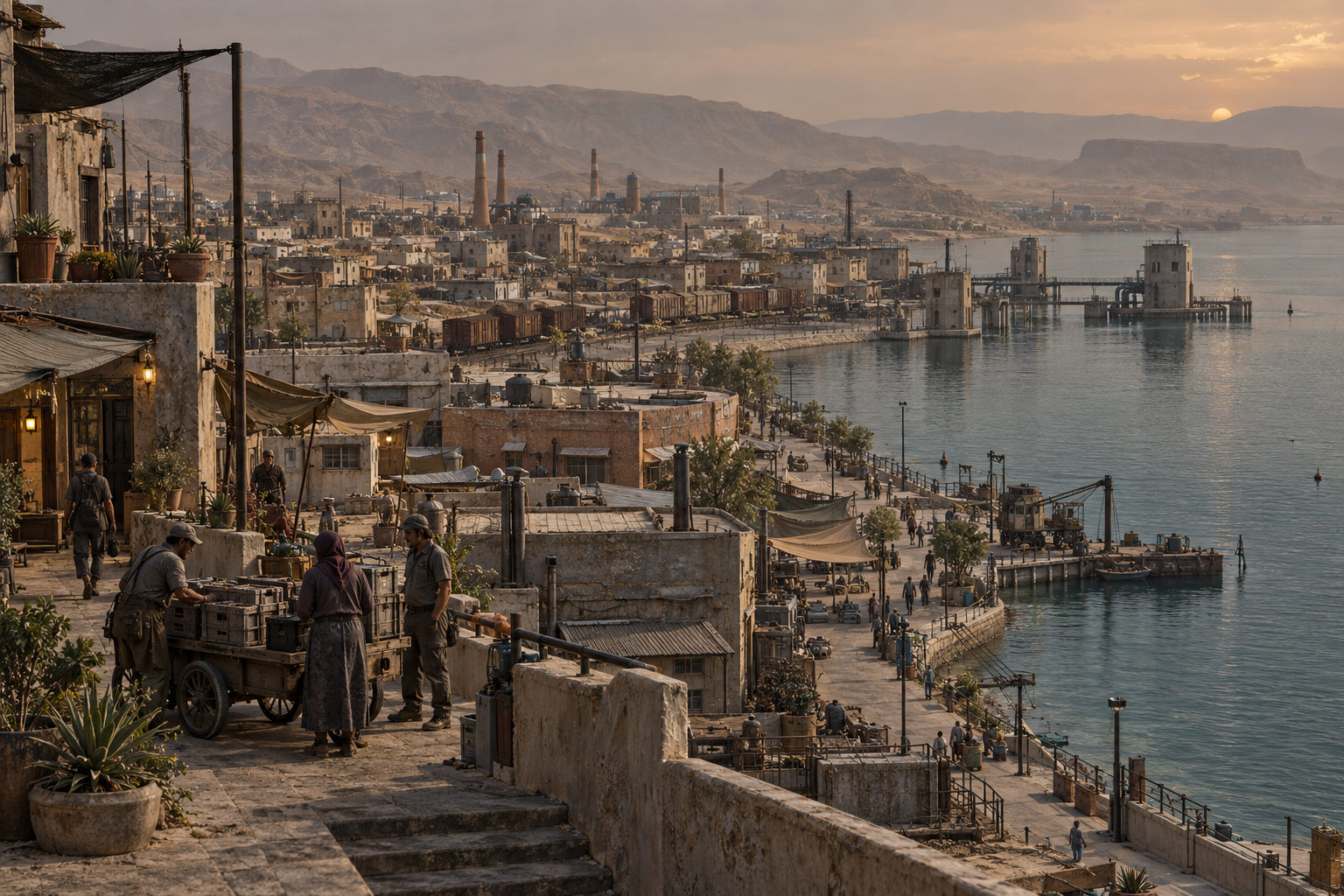
Orchards, pulse crops and market gardens occupy favoured terraces. Open grazing and mixed farming continue where rainfall and soils permit. Reservoir storage is only one part of supply; smaller catchments, covered cisterns and regulated wells matter to settlements beyond the capital. Overdrawing one source can damage another district long before a minister sees the result in a table.
Homes use shade courts, thick insulating walls and ventilated roof spaces. Wealthier households enjoy larger planted courts, while poorer tenants may rent rooms beneath roofs that store afternoon heat. Cooking moves between indoor and sheltered outdoor spaces with the season. Covered street fountains are places to meet, quarrel and examine the quality of someone else's shopping. A fountain's opening hours can shape a household's morning more directly than a national speech.
Salt rush and low silverleaf scrub cover the Kesh margins. Rain frogs spend dry periods sealed beneath the basin clay; their brief choruses after rain can drown a conversation outside the orchard houses. Orchard moths pollinate late fruit and also damage stored produce, so growers distinguish a useful insect in the field from one in a granary. Seed refuges on the basin’s saline edge conserve hardy varieties while adjoining communities contest grazing exclusions. Temperatures vary too sharply with elevation and shade for the capital’s weather notices to serve the entire country.
3. History and founding documents
The surviving Basin Rolls begin in SR 172, but cultivation and settlement are older. Early rolls record deliveries and claims rather than a complete population. Families possessing written shares could defend rights across generations; those whose work appeared only as hired labour acquired a much weaker documentary inheritance. Several present disputes arise from that difference rather than from an ancient agreement everyone accepted.
The Reservoir Bonds of SR 590 financed linked storage and freight improvements under the former Council of Water Stewards. Bondholders gained enforceable claims over revenue, while stewards retained hereditary influence over distribution. A later sequence of failed harvests, freight stoppages and contested charges produced the Basin Settlement of SR 624. Borough delegates and rural associations compelled the resignation of the hereditary council and established an elected assembly. The republic did not begin with every older property claim cancelled.
The Residence Act of SR 647 widened citizenship beyond households already entered in irrigation records. Its effect was substantial but incomplete. Proof of residence remained easier for a tenant with formal papers than for a seasonal labourer staying in employer accommodation. The present Water Account reform seeks clearer disclosure of transfers and charges. It is a contested bill, not a completed transformation celebrated in advance.
4. Government, law and politics
Twenty-four electoral districts each return two Assembly members for four local years. District boundaries are periodically reviewed; equal seats despite unequal populations remain an argument between growing towns and rural districts. The Assembly elects a First Convenor, limited to two consecutive terms, who appoints ministers subject to confirmation. Municipal councils run local services. Independent judges hear ordinary disputes, while a national constitutional bench can review legislation and executive orders.
Adult citizens vote without owning land or water shares. Citizenship generally requires two years of recognised residence and a recorded application. Critics focus on recognition: a person may spend years harvesting in the basin without accumulating the documents accepted at the counter. The government proposes additional evidence routes through schools, clinics and verified employment. Some councils support the principle and resist funding the staff it would require.
Irrigation associations retain votes weighted by historical shares for specified operational decisions. Those votes are separate from national elections, yet they influence who receives water at useful times. Reformers distinguish a protected allocation from a right to control everyone else's access. Established growers argue that new rules could ignore investments and maintenance burdens. Neither an electoral majority nor an old seal makes those material questions disappear.
5. Economy, labour, finance and trade
Selnic supplies ceramics, salts, preserved orchard products, grain from suitable districts and components manufactured around its freight towns. Glazed storage vessels are valued across the rim, although only a small part of production leaves Tarsenne. Local households need roofing, drains and durable cooking pots more regularly than a distant collector needs another decorated jar. The busiest workshops move between ordinary contracts and commissioned work according to demand.
Rail and road carriers connect inland producers with coastal buyers. Haulage contracts separate the sale of goods from responsibility for storage losses. Labour organisations are strongest among freight and kiln workers; seasonal agricultural crews possess fewer bargaining advantages. Heat schedules, dust exposure and secure accommodation are recurring subjects of dispute. Some employers provide good housing because skilled returning workers are difficult to replace. Others profit from the difficulty of leaving.
Cooperative credit rooms, private lenders and municipal savings offices operate under different rules. The Water Accounts Office records transferable rights but does not guarantee that a purchased share will yield an identical flow in every season. The illustrative account below belongs to a Tessovar household with one regular workshop wage and variable sewing income. It is expressed in local measures and cannot be compared directly with Halvyr's marks.

| Illustrative thirty-day account | Measures | Meaning |
|---|---|---|
| Workshop wage and sewing receipts | 310 | Combined take-home income in an ordinary working month |
| Rent | 62 | Three rooms opening onto a shared court |
| Food | 94 | Mostly purchased staples and fresh produce |
| Water and sanitation | 24 | Household service charges, not agricultural rights |
| Power and cooking fuel | 19 | Seasonal use varies |
| Transport | 17 | Local fares and household freight |
| School, clothing and work materials | 41 | Includes sewing inputs |
| Debt repayment | 23 | Remaining cost of a replacement sewing machine |
| Balance | 30 | Reserve available only if expected receipts arrive |
6. Population, education, health and welfare
The republic's population concentrates in basin towns and cultivated corridors. Settlement registers miss some residents of temporary work camps and count others in their home district after they have moved. National estimates therefore use rounded ranges beneath the headline total. Citizenship is a legal category, not a reliable description of language, ancestry or loyalty. Families commonly include members with different documentary status.
Public schools teach Selni, arithmetic, science and constitutional history, with additional language instruction where teachers are available. Colleges train clinicians, potters, surveyors, accountants and agricultural specialists. Evening classrooms serve adults who left school early or arrived speaking another language. Examinations matter, but a pupil's ability to study in a cool, quiet room is unevenly distributed. Libraries lend recordings as well as printed material.
Municipal clinics and national referral centres share health provision. Safe water, dust reduction and shaded work are public-health issues alongside treatment. Minimum emergency care does not depend on a completed citizenship application; longer-term entitlements and reimbursement produce more disagreement. Childcare cooperatives and public kitchens help households through interrupted earnings. Their users include people with jobs. The absence of an empty stomach at school may represent substantial work performed by adults who never appear in the education statistics.
7. Culture, arts, faith and communications
Evening brings much of Tessovar's sociability into the street. Shops reopen, shadowed courts host music and families bring stools outside. Painted ceramics record household events as often as official anniversaries. The best-known dramatic form alternates spoken scenes with a chorus that contradicts the actors' account of what happened. Audiences argue over which voice deserves belief; a successful performance can leave the entire street discussing the wronged secondary character.
Several faith traditions coexist. Keepers of the Quiet Room set aside undecorated spaces for mourning, reflection and private vows. Some regard silence as a way of receiving the dead; others explicitly reject that interpretation. The Basin Witness congregations emphasise spoken obligations and communal memory. Secular families may share the same funeral meals without sharing either explanation. No single practice defines every Selni household.
Local networks carry lessons, announcements, comedy and fiercely edited news. Registered publications can criticise ministers, while defamation disputes, ownership and access costs constrain speech in less dramatic ways. Outside well-connected corridors, carriers deliver stored messages with goods. Letters from other rim worlds may arrive together after long silence. A household can hear three stages of a relative's courtship in one evening and discover that its advice is already obsolete.
Ceramic artist Belessa Ruun made her reputation with household bowls whose painted interiors depict the rooms in which they were used. A cracked washbasin from her early work is more famous than several later royal commissions abroad. At Tessovar’s small Design House, students study the glaze repairs as carefully as the brushwork; collectors have been known to find this emphasis disappointing.
8. Science, services, powers and defence
Research centres work on soils, materials, water losses and power storage. Reservoir measurements are published with dates and method notes because a reassuring number without its location can conceal a failing district. Solar installations and storage serve many settlements, supplemented by other generation. Pump stations have independent reserve arrangements. Engineers distinguish water in storage from water that functioning equipment can actually deliver.
Psionic teaching occurs through licensed professional schools and private traditions. Licensing applies to paid services exposing others to risk, rather than declaring that every unusual experience is a state credential. Courts require ordinary evidence; a practitioner claiming to perceive dishonesty must still support an accusation. Spellcraft schools use mana, preparation and material methods distinct from psionic discipline. Certain coatings and worked seals help preserve containers, but their limits, maintenance and makers remain part of the contract.
The defence service protects freight approaches, power facilities and population centres. It includes engineering, medical, reconnaissance and armed units under civilian command. Emergency mobilisation requires an Assembly review. Selnic maintains local aircraft and ground vehicles; its procurement of sophisticated components depends partly on outside suppliers. A freight yard is not a spaceport, and the presence of an offworld contractor does not offer an ordinary traveller an available ship.
Orinthian buyers contract for selected production lots because reliable small components matter to large machines. Contracts disclose civilian orders already promised and reserve capacity required by Selnic. These suppliers remain subject to republican law. Their importance to an empire gives negotiators leverage, without making the basin an unlimited arsenal.
| Named centre | Product and uses | Required inputs | Route | Buyers and authority | Bottleneck |
|---|---|---|---|---|---|
| West Exchange machine cooperatives, Tessovar | Bearings and machine repair for freight vehicles and military support equipment | Halvyr metal, lubricants and imported cutting tools | Basin freight line to booked coastal export lots | Local carriers and Orinthian contractors; republican jurisdiction | Tool wear and skilled finishing |
| Delsic Ceramic Houses | Precision insulators and seals for pumps, communications and power systems | Graded minerals, reliable kiln power and specialist compounds | Road to Tessovar, then licensed coastal brokers | Civil manufacturers and defence purchasers; specified lots only | Consistent firing and rejection rates |
| Serat Pump Yards | Pumps and overhaul kits for farms, settlements and field supply units | Bearings, ceramic seals, motors and controls from several suppliers | Eastern freight plain through Tessovar | Municipal customers first, contracted exports including Orinth | Imported motor controls and seasonal domestic demand |
9. Sport and recreation
Shade-court ball is played with low walls, a soft ball and rules that reward placement more than strength. Neighbourhood competitions produce elaborate arguments over boundaries painted by the home team. Competitive kite flying belongs to designated open ground beyond roofs and utility lines. Reservoir boating uses marked recreation reaches and is prohibited near working intakes; good swimming ability does not confer access to treatment infrastructure.
Walking clubs leave early to avoid exposed heat. Evening cycling, dance, dramatic societies and ceramic decoration attract people who have little interest in organised competition. Children build miniature courts in dust and borrow rules from older siblings. Older residents play stone-placement games under arcades, where spectators possess considerable certainty and no responsibility for the result.
The republic's quarter observances mark the changing local season, not the same weather as southern Orsala. Public celebrations include markets, performances and shared meals. Households also make private holidays from an unhurried visit, a favourite fruit coming into season or an afternoon when the courtyard is finally empty. Recreation policy is debated through lighting, transport and opening hours as much as through grand venues.
10. SR 683 review, sources and directory
The current review identifies citizenship documentation, irrigation representation and labour housing as active disputes. The population estimate combines district registers and the Basin Statistical Office's seasonal adjustments. The household basket is an example in local currency; it does not provide a common measure for ranking national wealth.
Visitors should distinguish the national government, a municipal service and an irrigation association before deciding who can answer a request. Residents make the same distinction under less forgiving conditions, often while losing a day's earnings. The republic's institutions are most tangible when a person can identify an accountable office and obtain an answer that changes something.
During completed SR 682, Serat’s common repair yard added a second inspection bay, two outer districts began an evening teacher exchange, and Tessovar hosted an exhibition of repaired household ceramics. None settled the pending Water Account bill. The repair yard shortened some queues, but a shortage of trained finishers kept it from simply doubling output.
| Office or record | Where to begin | Purpose |
|---|---|---|
| Assembly public office | Tessovar | Bills, representatives and published decisions |
| Residence registry | Municipal offices | Citizenship evidence and registration review |
| Water Accounts Office | Tessovar and district counters | Recorded allocations and disclosed transfers |
| Basin Referral House | Tessovar | Specialist health referrals and visiting-patient arrangements |
| Basin Rolls; Reservoir Bonds; Basin Settlement | Public archive copies | Historical claims, finance and the SR 624 constitutional change |
The old share beneath the new vote
The Basin Settlement of SR 624 removed hereditary national government without making every inherited allocation communal. A citizen's equal Assembly vote therefore coexists with unequal influence over a particular channel. The distinction is visible in a farm household that votes against a minister and still needs the minister's cousin to approve an irrigation schedule. It is also why reform proposals separate ownership, maintenance obligations and operational voting rather than treating them as one right.
After the Residence Act of SR 647, employers began supplying standard accommodation certificates for workers who applied for citizenship. Honest certificates helped. Others expired with the job, leaving the employer in possession of the evidence needed to leave its lodging yard. School attendance and clinic records can support a contested application under existing evidential procedures; the pending reform would broaden and clarify access, not create residents who were previously imaginary.
The contract that follows the crop
Delsic orchard crews commonly move as households or groups of relatives. Their pay depends on harvest work while their costs continue through every waiting day. Labour organiser Omira Senn keeps sample contracts at market sessions, marking deductions for water, bedding and tools in a different colour from wages. Some employers invite her because disputes spoil future recruitment; others discover urgent maintenance whenever she requests a room.
Tenant growers can borrow against crops not yet picked. A failed pump then creates three debts at once: repair, household food and the lost delivery promised to the lender. Cooperative credit rooms offer alternatives but have finite reserves and membership terms. Public kitchens and childcare make it possible for adults to contest an account without leaving children hungry. They remain services used by working people, not a measurement of who has ceased to try.
Clean tolerances in a dirty district
Delsic Ceramic Houses separate dusty preparation from firing, inspection and protected packing. Fine ceramic particles damage lungs as well as finishes. A white coating on a worker's sleeve can look reassuringly clean while representing the day's worst exposure. Extraction systems require filters and maintained seals; washing the floor shortly before an inspection does not recover the dust already breathed.
Certain older kilns and metal-recovery furnaces release sulphurous exhaust when poor fuel or failed scrubbers are tolerated. Local first-rain samples can become acidic near these premises, injuring orchard leaves and corroding unprotected fittings. The pattern is measured downwind and varies with operation and weather. Neither Tessovar's whole reservoir nor every Selnic field shares that condition. Firms disputing liability must disclose operating records, which is where several mysteriously restful maintenance weeks acquire a different meaning.
| Product chain | Useful output | Failure that travels beyond the factory |
|---|---|---|
| Delsic minerals, kilns and inspection | Insulators and precision seals | A cracked seal can disable a municipal pump |
| West Exchange tools and finishing | Bearings and repaired machinery | Poor fit consumes fuel and damages a carrier's equipment |
| Serat assembly and test bays | Pumps and overhaul kits | Unreliable controls leave stored water undeliverable |
| Orchards and preservation houses | Fruit, food and packing work | Contaminated washing or bad storage destroys a distant household's purchase |
Dry places with teeth and roots
Kesh salt margins support small bristle-backed coursers that hunt burrowing animals at dusk. Adults avoid groups but defend dens fiercely; grazing households teach children to recognise their paired entry scrapes. Destroying dens indiscriminately increases crop pests and encourages scavengers near settlements. Local keepers close paths around occupied sites rather than presenting a bounty as a complete ecological policy.
Saltglass creeper threads roots into cracked irrigation masonry, its translucent new stems difficult to see in hard light. Farmers value its fibre on uncultivated margins and curse it in channels. Pulling a mature mat out can open the very crack it helped conceal. Water crews cut, isolate and rebuild in sequence. A contractor paid only by the length cleared has an excellent reason to omit the last two operations.
People who maintain the republic
Scientific stations compare shaded and exposed temperatures, salinity, crop results and actual delivered water. Technical schools teach apprentices to retain failed readings and explain exclusions. Public data are useful only if remote districts can receive and interpret them; recorded lessons travel with carriers where networks fail. Older pupils sometimes act as household readers without thereby becoming substitutes for paid inspectors or clinicians.
Paid psionic services require relevant licensing, and claims of hidden guilt remain insufficient evidence. Spellworkers maintaining container treatments keep material and renewal records beside ordinary pressure tests. Defence engineering units train with municipal crews while retaining distinct command. Protecting a pumping station also means preserving its workers' ability to refuse an unsafe restart. Under civilian mobilisation rules, urgency can bring scrutiny sooner; it does not turn a cracked housing sound.
An evening that belongs to its participants
Basin Witness gatherings recount promises aloud; Quiet Rooms allow mourners to refuse an audience. Families may use both in the same year. Food stalls serve pulse cakes, salted vegetables, orchard preserves and flat breads warmed after the worst heat. A shared meal can be cheap because several households contributed labour, not because food has stopped costing anybody.
Street choruses contradict the actors, and occasionally a councillor who believed attending the performance would improve her popularity. Shade-court ball and kite clubs argue about public space with traders and residents trying to sleep. Ceramic collectors admire Belessa Ruun's repaired bowls while ordinary potters produce the vessels that keep water covered. On a good evening nobody mistakes the absence of a national emergency for the absence of something worth doing.